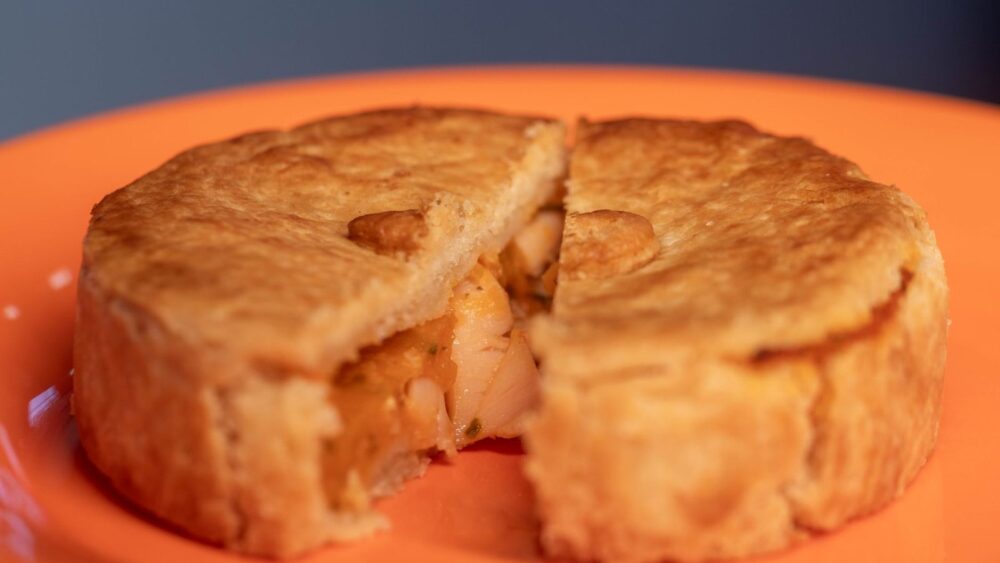

Chicken pot pie is comfort food with a built-in shortcut. Start with cooked chicken and a box of refrigerated pie crusts, and the only real work is a quick, creamy filling made in one skillet.
The filling is thick enough to slice cleanly, seasoned with thyme and a little black pepper, and loaded with carrots, celery and peas. The crust bakes up golden and flaky on top and stays crisp on the bottom, thanks to one simple trick with a preheated baking sheet.
Plan on about 30 minutes of hands-on time, then let the oven take over while you set the table. It is also one of the best dinners to assemble ahead and freeze, so a homemade pot pie can be ready on a night when you have no time to cook at all.
Why this recipe works
- A proper roux. Cooking flour in butter before adding liquid gives a smooth, stable sauce that thickens as it bakes and sets as it rests.
- Broth plus milk. Using both keeps the filling rich without being heavy, and the broth adds savory depth that milk alone would not.
- Cooked chicken. Rotisserie chicken or leftover roast chicken saves time and stays tender because it only needs to heat through.
- A hot baking sheet. Setting the pie on a preheated sheet on the lower rack sends heat straight into the bottom crust so it browns instead of turning soggy.
- Resting time. Fifteen minutes out of the oven lets the filling set so each slice holds together.
Ingredients you’ll need
Exact amounts are in the recipe card below. A few notes on the key players:
- Cooked chicken. You need about 3 cups, shredded or diced. A standard rotisserie chicken usually gives you that amount. Leftover roast chicken or turkey works just as well.
- Refrigerated pie crusts. One 14.1 oz box contains two rolled crusts, exactly what a double-crust pie needs. Homemade all-butter pie dough is a great swap if you have it.
- Butter and flour. These form the roux that thickens the filling. Use unsalted butter so you can control the seasoning.
- Chicken broth. Low-sodium broth is best, since rotisserie chicken is often already salty.
- Whole milk. It gives a creamy texture. Half-and-half makes it richer. Avoid skim milk, which makes a thinner sauce.
- Vegetables. Onion, carrots, celery and frozen peas are the classic mix. Diced potatoes, green beans or corn also fit right in.
- Thyme. Dried thyme is the traditional herb here. A little fresh parsley or sage is a nice addition.
Ingredient notes and smart substitutions
Pot pie is forgiving, but a few swaps change the texture of the filling or the crust more than you might expect. Here is what to know.
Chicken
Rotisserie chicken is the easiest route and one bird gives about 3 cups. If you are cooking chicken from raw, poach 1 1/2 lb boneless thighs or breasts in simmering broth for 12 to 15 minutes until they reach 165°F, then shred. Thighs stay juicier in the filling. Leftover turkey swaps in cup for cup.
Pie crust
A 14.1 oz box of refrigerated crusts is sized for a 9-inch pie. Homemade all-butter dough for a double crust (about 2 1/2 cups flour) works the same way and browns a little more. Puff pastry only works as a top crust; it will not hold up on the bottom. Do not use a graham or cookie crust.
Butter and flour
The ratio of 6 tbsp butter to 1/2 cup flour thickens 3 cups of liquid to a filling that slices cleanly. For a lighter filling, drop to 4 tbsp butter and 1/3 cup flour and expect it to be softer. For gluten-free, use a 1:1 gluten-free flour blend in the roux and a gluten-free crust; a cornstarch slurry also works, but the filling will be glossier and less creamy.
Milk
One cup of whole milk can be replaced with 1 cup half-and-half for a richer filling, or 3/4 cup whole milk plus 1/4 cup heavy cream. For dairy-free, use 1 cup unsweetened oat milk and swap the butter for a plant-based butter; the filling will be slightly thinner, so simmer it an extra minute or two.
Broth
Low-sodium chicken broth is best. If you have the poaching liquid from cooking the chicken, use it; it is more flavorful than boxed. Bouillon paste dissolved in water is a good backup at 1 tsp per cup.
Vegetables
Fresh carrots and celery give the best texture. If you use a 12 oz bag of frozen mixed vegetables in place of the carrots, celery and peas, add it straight from frozen after the sauce thickens and skip the 7-minute sauté; just cook the onion alone. Diced potato needs to be parboiled for 5 minutes first.
Thyme and seasonings
One teaspoon dried thyme equals 1 tbsp fresh. Poultry seasoning is a good substitute at the same amount. A pinch of nutmeg or 1 tsp Dijon stirred into the sauce adds depth without tasting of either.
How to make it
1. Get the oven and crust ready
Put a rimmed baking sheet on the lowest oven rack and heat the oven to 400°F. Let the refrigerated crusts sit at room temperature for about 15 minutes so they unroll without cracking. Fit one crust into a 9-inch deep-dish pie plate.
2. Soften the vegetables
Melt the butter in a large skillet and cook the onion, carrots and celery until the onion is soft and the carrots are just starting to give, about 7 minutes. Add the garlic for the last minute.
3. Make the sauce
Sprinkle the flour over the vegetables and stir for 1 to 2 minutes. This cooks out the raw flour taste. Slowly pour in the broth while stirring, then the milk, and simmer until the sauce is thick enough to coat the back of a spoon.
4. Finish the filling
Stir in the chicken, peas and thyme, then season well with salt and pepper. Taste it here. The filling should be well seasoned, because the crust is fairly neutral. Let it cool for about 10 minutes so it does not melt the bottom crust before it goes into the oven.
5. Assemble and bake
Pour the filling into the crust, lay the second crust on top, trim and crimp the edges, and cut a few slits so steam can escape. Brush with beaten egg and bake on the hot sheet until the crust is deep golden and the filling bubbles through the vents.
Common mistakes and how to fix them
Soggy bottom crust. The filling went in hot, or the pie baked on a middle rack with no direct bottom heat. Fix: cool the filling 10 minutes, bake on a preheated sheet on the lowest rack, and use a metal or glass pie plate rather than thick ceramic, which insulates the crust.
Runny filling. The sauce was pulled off the heat before it thickened, or the pie was cut before resting. Fix: the sauce should coat the back of a spoon and hold a line when you drag a finger through it. If it is already baked, let it rest 20 minutes; the filling firms as it cools.
Filling that leaks out the edges. The pie was overfilled or the seal was weak. Fix: fill no higher than 1/2 inch below the rim, press the top crust firmly to the bottom crust before crimping, and set the pie on a rimmed sheet to catch drips.
Top crust browned before the filling is hot. The oven was too hot or the pie went in straight from the fridge. Fix: tent the top loosely with foil once it is golden and keep baking until the center reads 165°F and the filling bubbles at the vents.
Pale, greasy crust. The crust sat on the counter too long and the butter softened. Fix: work quickly, chill the assembled pie for 10 minutes before baking if the kitchen is warm, and brush with egg wash right before it goes in.
Bland filling. Rotisserie chicken and store crusts vary in salt, and the crust dilutes everything. Fix: taste the filling and season until it tastes slightly too salty on its own. Add 1 tsp lemon juice if it tastes heavy.
Timing and make-ahead plan
- Up to 2 days before: Cook the filling, cool it, and refrigerate in a covered container. Pull the chicken from a rotisserie bird at the same time.
- The morning of: Let the refrigerated pie crusts sit out 15 minutes, line the pie plate with the bottom crust and refrigerate it uncovered.
- 1 hour 15 minutes before serving: Put the sheet pan in the oven and heat to 400°F. Fill the cold crust with the cold filling, top, vent and brush with egg.
- 1 hour before: Bake for 40 to 45 minutes; cold filling needs a little longer than the recipe time.
- 15 minutes before: Rest the pie on a rack.
To hold a baked pot pie for guests, keep it uncovered in a 200°F oven for up to 45 minutes. Covering it will soften the crust.
Tips for the best chicken pot pie
- Do not skip the vents. Without them, steam builds up under the top crust and can make it puff unevenly or turn gummy underneath.
- Shield the edges if needed. If the crimped edge browns faster than the center, cover it loosely with strips of foil or a pie shield for the rest of the bake.
- Check for bubbling. Thick bubbles coming through the slits tell you the filling is hot all the way through. Since the chicken is already cooked, you are aiming for the center to reach 165°F.
- Season the filling boldly. Under-seasoned filling is the most common reason a pot pie tastes flat.
- Let it rest. Cutting in right away gives you a runny slice. Fifteen minutes makes all the difference.
Variations
- Biscuit-topped pot pie. Skip the crusts, pour the filling into a 9×13-inch baking dish and top with raw biscuits. Bake at 400°F until the biscuits are golden and cooked through, about 20 to 25 minutes.
- Puff pastry top. Use a single sheet of thawed puff pastry over the filling in a baking dish for a crisp, shatteringly flaky lid.
- Turkey pot pie. Swap in leftover roast turkey. It is a good way to use up holiday leftovers.
- Individual pies. Divide the filling among oven-safe ramekins, top each with a round of crust and bake for about 25 minutes.
- Mushroom and leek. Replace the onion with two sliced leeks and add 8 oz of sliced mushrooms with the vegetables.
Equipment that makes this easier
- A 9-inch deep-dish pie plate. A standard 9-inch plate is about 1 1/4 inches deep and will overflow with this much filling. Deep-dish plates are about 2 inches deep.
- A rimmed baking sheet. Preheating it crisps the bottom crust and catches any bubbling filling.
- A 12-inch skillet or wide saucepan. The filling needs room to simmer and reduce; a small pot takes longer to thicken.
- A pastry brush. A thin, even coat of egg wash gives the shiny, deep golden top without pooling in the crimps.
- A pie shield or foil strips. The edge browns first and needs protection in the last 10 to 15 minutes of most bakes.
- An instant-read thermometer. It is the only sure way to know a frozen or make-ahead pie has reached 165°F in the center.
Scaling up or down
To halve the recipe, make the full filling anyway and freeze half; a half batch of roux is fiddly to make in a large skillet. Bake the halved amount in a 6-inch pie plate or two 10-oz ramekins with one crust, cut to fit, for 25 to 30 minutes.
To double the recipe, make two pies rather than one giant pie. A 9×13-inch dish holds a double batch of filling with a single top crust (use both crusts from one box, overlapped and pressed together) and bakes in 40 to 45 minutes at 400°F. Doubled filling takes 6 to 8 minutes to thicken instead of 3 to 5, so keep stirring and be patient before adding the chicken. Two pies on the same rack should have 2 inches of space between them and may need 5 extra minutes.
What to serve with it
Pot pie already has protein, vegetables and a starch in every slice, so keep the sides light.
- A green salad with apples and a cider vinaigrette.
- Roasted green beans, glazed carrots or cranberry sauce. There are more ideas in these fall side dishes that go with everything.
If you love creamy chicken bakes, this chicken and wild rice casserole is another hearty option, and classic beef stew brings the same cozy feel with beef.
How to store, freeze and reheat
Refrigerator: Cover leftovers and refrigerate for up to 4 days.
Freeze unbaked: Assemble the pie in a metal or freezer-safe pie plate, but do not brush with egg or cut vents. Wrap tightly in plastic wrap and foil and freeze for up to 3 months. Bake from frozen at 400°F: cut vents, brush with egg, and bake on the hot sheet for 60 to 75 minutes, covering the top loosely with foil if it browns too quickly, until the center reaches 165°F. Pot pies are a natural fit for a fall freezer meal prep day.
Freeze baked: Cool completely, wrap and freeze for up to 3 months. Thaw overnight in the fridge before reheating.
Reheat: Warm slices in a 350°F oven for 15 to 20 minutes, until hot in the center. The microwave works for a single slice, though the crust will soften.
Leftover ideas
- Pot pie soup. Scrape leftover filling into a pot, add 2 cups chicken broth and 1/2 cup milk, and simmer. Crumble the crust over the top like crackers.
- Hand pies. Wrap cold filling in rounds of leftover or fresh pie dough, crimp, brush with egg and bake at 400°F for 20 to 25 minutes.
- Pot pie over biscuits. Warm the filling only and spoon it over split, toasted biscuits or an English muffin.
- Stuffed baked potatoes. Top split baked potatoes with hot filling and a little shredded cheddar.
- Chicken pot pie casserole. Combine leftover filling with 2 cups cooked egg noodles in a baking dish and bake at 375°F until bubbling, about 20 minutes.
Nutrition notes
One slice (one-sixth of a double-crust pie) is roughly 560 to 650 calories, 26 to 30 g protein, 42 to 48 g carbohydrates and 30 to 36 g fat. The crust accounts for nearly half of that. Estimates vary with the brand of crust, how much skin is in the rotisserie chicken, and how generously you slice.
- Lighter: Use a single top crust in a 9×13-inch dish, which drops about 150 calories per serving, and use skinless chicken breast.
- Less fat: Reduce the butter to 4 tbsp and the flour to 1/3 cup for a slightly thinner filling.
- Gluten-free: Use a 1:1 gluten-free flour blend in the roux and a gluten-free pie crust, and check the broth label.
- Dairy-free: Plant-based butter, unsweetened oat milk and a dairy-free crust (many refrigerated crusts are made with shortening; check the label) get you there.
Homemade Chicken Pot Pie
A creamy chicken, vegetable and thyme filling baked in a flaky double crust.
Equipment
- 9-inch deep-dish pie plate
- Large skillet
- Rimmed baking sheet
Ingredients
For the filling
- 6 tbsp unsalted butter
- 1 medium yellow onion, diced
- 2 medium carrots, peeled and diced
- 2 celery stalks, diced
- 3 cloves garlic, minced
- 1/2 cup all-purpose flour
- 2 cups low-sodium chicken broth
- 1 cup whole milk
- 3 cups cooked chicken, shredded or diced
- 1 cup frozen peas
- 1 tsp dried thyme
- 3/4 tsp kosher salt, or to taste
- 1/2 tsp black pepper
For the crust
- 1 (14.1 oz) box refrigerated pie crusts (2 crusts)
- 1 large egg, beaten with 1 tbsp water
Instructions
- Place a rimmed baking sheet on the lowest oven rack and heat the oven to 400°F. Let the pie crusts stand at room temperature for 15 minutes, then fit one crust into a 9-inch deep-dish pie plate.
- Melt the butter in a large skillet over medium heat. Add the onion, carrots and celery and cook, stirring occasionally, until the onion is soft, about 7 minutes. Add the garlic and cook for 1 minute.
- Sprinkle the flour over the vegetables and cook, stirring constantly, for 1 to 2 minutes.
- Slowly pour in the broth while stirring, then stir in the milk. Bring to a simmer and cook, stirring often, until thick enough to coat the back of a spoon, 3 to 5 minutes.
- Stir in the chicken, peas, thyme, salt and pepper. Taste and adjust the seasoning. Remove from the heat and let cool for 10 minutes.
- Pour the filling into the prepared crust and spread evenly. Lay the second crust on top, trim the overhang to about 1 inch, fold it under and crimp the edges. Cut 4 or 5 slits in the top.
- Brush the top with the egg wash. Set the pie on the preheated baking sheet and bake for 35 to 40 minutes, until the crust is deep golden and the filling is bubbling through the slits. Cover the edges with foil if they brown too quickly.
- Let the pie rest for 15 minutes before slicing and serving.
Notes
- Chicken: One rotisserie chicken usually yields about 3 cups of meat. Leftover turkey works too.
- Make ahead: The filling can be made up to 2 days ahead and refrigerated. Assemble and add 5 to 10 minutes to the baking time.
- Freezing: Freeze the assembled, unbaked pie for up to 3 months and bake from frozen at 400°F for 60 to 75 minutes, until the center reaches 165°F.
- Food safety: Because the chicken is already cooked, reheat the filling until the center reaches 165°F.
Frequently asked questions
How do you keep the bottom crust of a pot pie from getting soggy?
Let the filling cool slightly before adding it to the crust, and bake the pie on a preheated baking sheet on the lowest rack. The direct heat helps the bottom crust set and brown.
Can I use raw chicken in chicken pot pie?
It is best to cook the chicken first. Raw chicken will not cook evenly inside the pie in the baking time. Poach or roast it first, or use rotisserie chicken.
Why is my chicken pot pie runny?
The sauce was likely not simmered long enough to thicken, or the pie was cut before it rested. Simmer the sauce until it coats a spoon, and let the baked pie rest for 15 minutes.
Can I make chicken pot pie ahead of time?
Yes. Make the filling up to 2 days ahead and refrigerate it, or assemble and freeze the whole unbaked pie for up to 3 months.
Can I make chicken pot pie in a 9×13 baking dish?
Yes. Spread the filling in the dish and cover it with a single top crust made from both refrigerated crusts overlapped and pressed together, or a sheet of puff pastry. Bake at 400°F for 35 to 45 minutes, until the crust is golden and the filling bubbles at the edges.