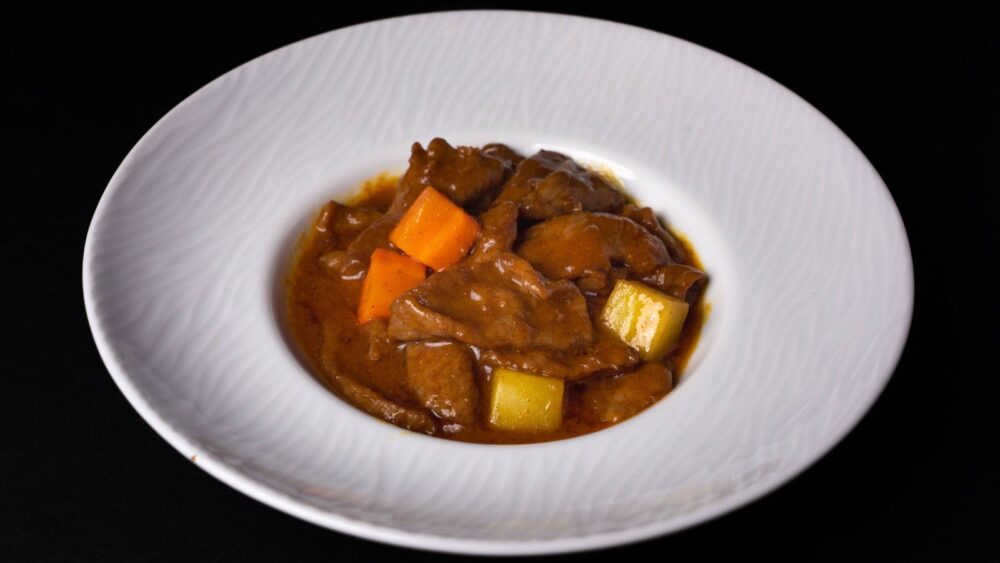

A good beef stew is mostly patience. Brown the meat well, give it a slow, low braise, and add the potatoes late so they hold their shape. Do those three things and the pot does the rest.
This version is built for a chilly Sunday. It takes about three hours start to finish, but most of that time the stew sits quietly in the oven while the chuck turns spoon-tender and the broth thickens into a rich, savory gravy.
It also reheats beautifully, so it is just as good as a make-ahead dinner for a busy weeknight.
Why this recipe works
- Chuck roast, cut yourself. Chuck has plenty of connective tissue that melts during a long braise, which is what makes the meat tender and the gravy silky.
- Browning in batches. Crowding the pot makes the beef steam instead of sear. Two or three batches build a dark fond on the bottom of the pot, and that fond is where the deep flavor comes from.
- Oven braising. The oven surrounds the pot with gentle, even heat, so nothing scorches on the bottom and you do not need to stir constantly.
- Potatoes go in later. Adding them for the last hour keeps them soft but intact instead of falling apart into mush.
- Flour on the vegetables, not the meat. Stirring flour into the softened vegetables thickens the stew evenly without the gummy coating that dredged meat can leave behind.
Ingredients you’ll need
The full amounts are in the recipe card. Here is what matters about the key ingredients.
- Beef chuck roast. Buy a whole 2 1/2 lb chuck roast and cut it into 1 1/2-inch cubes. Packaged stew meat is often a mix of cuts that cook at different rates, so some pieces end up dry while others are still chewy.
- Dry red wine. A cabernet, merlot or any dry red you would drink works. It adds acidity and depth. If you skip it, use an extra cup of beef broth plus 1 tablespoon of red wine vinegar.
- Beef broth. Low-sodium broth lets you control the salt, which matters because the liquid reduces as it cooks.
- Tomato paste and Worcestershire sauce. Both add savory, umami depth. Cook the tomato paste for a minute or two until it darkens slightly to take the raw edge off.
- Yukon Gold potatoes. They hold their shape better than russets and have a creamy texture. Red potatoes are a good swap.
- Carrots, onion and celery. The classic base. Parsnips are a nice fall addition if you want a little sweetness.
- Frozen peas. Stirred in at the end for color. Leave them out if they are not your thing.
Ingredient notes and smart substitutions
Most of the ingredients here are flexible. These are the swaps that work, the ones to avoid, and how each change affects the stew.
Beef chuck
Look for a roast with visible white marbling. Chuck-eye or chuck shoulder roast braise the same way. Brisket point is a good swap and needs about the same time; bottom round works but comes out drier and more crumbly. Do not use sirloin or tenderloin, which turn dry and stringy in a long braise.
Red wine
For 1 cup of wine, swap in 1 cup beef broth plus 1 tbsp red wine vinegar, or 1 cup dark beer with 1 tsp brown sugar. Both give a slightly less fruity gravy that is still rich. Skip cooking wine, which is salted and throws off the seasoning.
Beef broth
If you only have regular broth, cut the added salt in half and season at the end. For 3 cups of broth you can use 3 cups water plus 1 tbsp beef base paste, which often tastes deeper than boxed broth. Chicken broth works in a pinch but gives a lighter gravy.
Flour
The 1/4 cup of flour thickens about 4 cups of liquid to a light gravy. For a gluten-free stew, leave it out and whisk 2 tbsp cornstarch with 2 tbsp cold water into the finished stew, then simmer 2 minutes. Cornstarch gives a glossier, clearer gravy.
Potatoes
Yukon Golds and red potatoes hold their shape. Russets fall apart and thicken the stew on their own; if you use them, cut 2-inch pieces. Sweet potatoes cook faster, so add them for the last 40 minutes only.
Tomato paste and Worcestershire
Replace 2 tbsp tomato paste with 1/4 cup canned crushed tomatoes for a slightly thinner gravy. Worcestershire swaps 1:1 with soy sauce, which adds the same savory depth with a different edge.
Herbs
One teaspoon of dried thyme equals 1 tbsp fresh leaves or 4 to 5 sprigs tied together. Dried rosemary is much stronger, so use only 1/2 tsp if you substitute it.
How to make it
1. Prep and season the beef
Pat the beef cubes very dry with paper towels. Surface moisture is the enemy of a good sear. Season all over with salt and pepper just before browning.
2. Brown in batches
Heat oil in a large Dutch oven over medium-high heat until it shimmers. Add the beef in a single layer with space between pieces, and leave it alone for 3 to 4 minutes so a deep brown crust forms before you turn it. Transfer each batch to a plate and add a little more oil as needed.
3. Build the base
Lower the heat to medium, then cook the onion, carrots and celery in the drippings until softened. Add garlic and tomato paste, then the flour, and stir for a minute so the flour cooks and loses its raw taste.
4. Deglaze and braise
Pour in the wine and scrape up every browned bit from the bottom of the pot. Let it bubble for a couple of minutes, then add the broth, Worcestershire, thyme, bay leaves and the browned beef with its juices. Bring it to a simmer, cover and move the pot to a 325°F oven.
5. Add the potatoes
After 1 1/2 hours, stir in the potatoes, cover again and return the pot to the oven for another 45 to 60 minutes, until both the beef and potatoes are fork-tender.
6. Finish
Stir in the peas, let them warm through for a few minutes, then taste and adjust the salt and pepper. Remove the bay leaves before serving.
Common mistakes and how to fix them
Gray, steamed beef instead of browned. The pot was crowded or the beef was wet, so the surface never got hot enough to brown. Fix: pat the cubes dry, work in three batches, and wait for the oil to shimmer. If a batch starts to steam, pull half of it out.
Watery, thin stew. Usually the lid was ajar so condensation dripped in, or the potatoes were cut small and released starchy water. Fix: simmer uncovered on the stovetop for 10 to 15 minutes, or stir in a slurry of 1 tbsp cornstarch and 1 tbsp cold water and simmer 2 minutes.
Tough beef after 2 hours. Chuck goes through a tough stage before the collagen dissolves, so it is undercooked, not overcooked. Fix: give it another 20 to 30 minutes at 325°F. If the liquid is boiling hard, drop to 300°F; a hard boil squeezes moisture out of the fibers and makes the meat stringy.
Scorched bottom. This happens on the stovetop when the flour sticks and burns before the wine goes in. Fix: keep the heat at medium once the flour is added, stir constantly, and deglaze promptly. If you already see black bits, do not scrape them up; move everything to a clean pot.
Mushy potatoes. They went in at the start or were cut under 1 1/2 inches. Fix: add them in the last hour and keep the pieces big. Carrots can go in at the start, cut into 1-inch chunks rather than thin coins.
Flat flavor even though it is salted. Long braises taste muted because the acid cooks off. Fix: stir in 1 to 2 tsp red wine vinegar or a spoonful of Dijon just before serving, then taste for salt again.
Timing and make-ahead plan
Beef stew is one of the easiest dinners to make ahead, and it improves after a night in the fridge.
- Up to 2 days before: Make the stew through the potato step, but stop before adding the peas. Cool for no more than 1 hour at room temperature, then refrigerate.
- The morning of: Lift the solid fat off the top. Taste the cold stew and note whether it needs salt or acid.
- 45 minutes before serving: Warm it in a covered pot over medium-low heat, stirring every few minutes. Add a splash of broth if it has thickened.
- 10 minutes before serving: Stir in the peas, adjust seasoning and add parsley.
To hold the stew warm for guests, keep it covered on the lowest burner setting or in a 200°F oven for up to 2 hours, stirring every 30 minutes. A slow cooker on the warm setting works for up to 3 hours.
Tips for the best beef stew
- Dry beef browns, wet beef steams. Take the extra minute to pat every cube dry.
- Keep the braise gentle. If you check the pot and it is boiling hard, drop the oven to 300°F. A hard boil tightens the meat fibers and makes the beef stringy.
- Tender means tender. If the beef still resists a fork, it needs more time, not less. Give it another 20 to 30 minutes.
- Adjust the thickness at the end. Too thin? Simmer it uncovered on the stovetop for 10 minutes. Too thick? Add a splash of broth.
- Brighten it up. A small splash of red wine vinegar or a handful of chopped parsley right before serving wakes up the rich flavors.
- Make it a day ahead. Stew tastes even better the next day, and chilling it lets you lift off any hardened fat from the top.
Variations
- Guinness beef stew. Swap the red wine for a 12 oz bottle of stout and add 1 teaspoon of brown sugar to balance its bitterness.
- Mushroom beef stew. Brown 8 oz of quartered cremini mushrooms after the beef and add them back with the broth.
- Herb-forward. Add a sprig of rosemary with the thyme and finish with fresh parsley and a little lemon zest.
- Slow cooker version. Brown the beef and build the base on the stove, then transfer everything, including the potatoes, to a slow cooker and cook on low for 8 hours. For a hands-off roast in the same spirit, try this slow cooker pot roast with root vegetables.
- Shepherd’s pie twist. Leftover stew makes a great filling under mashed potatoes, much like this beef and mushroom shepherd’s pie.
Equipment that makes this easier
- A 6 to 7-quart enameled Dutch oven. Heavy cast iron holds heat for a steady sear and moves straight from stovetop to oven. Anything under 5 quarts will be crowded.
- A heavy skillet as a backup. If your pot is small, brown the beef in a skillet while the pot handles the vegetables, then combine.
- Paper towels and a large plate. Drying the beef is the most important step for browning, and the plate catches the juices you pour back in.
- A sharp chef’s knife. Even 1 1/2-inch cubes mean every piece finishes at the same time.
- An oven thermometer. Many ovens run 25°F hot or cold, which is the difference between a gentle braise and a rolling boil.
Scaling up or down
To halve the recipe (3 servings), use 1 1/4 lb chuck, halve everything else, and choose a 3 to 4-quart pot. Browning goes faster, but the braise still needs the full time, since cube size rather than total weight sets the clock. Check the potatoes at 40 minutes.
To double the recipe (12 servings), use a 9-quart or larger Dutch oven or split it between two pots. Brown 5 lb of beef in five or six batches, wiping out the pot if the fond starts to blacken. Double the liquids and flour, but increase the salt by only half at first, since doubled liquid reduces less. Bring the pot to a full simmer on the stovetop before it goes in the oven, and plan on an extra 30 to 45 minutes of braising.
If you are scaling up for the freezer, leave the potatoes out of the batch you plan to freeze and cook them fresh at serving time.
What to serve with it
Beef stew is a full meal on its own, but a few simple sides round it out.
- Crusty bread or warm biscuits for soaking up the gravy.
- A crisp green salad with a sharp vinaigrette to balance the richness.
- Roasted Brussels sprouts or green beans. You will find more ideas in these fall side dishes that go with everything.
If you are cooking for a special occasion, red wine braised short ribs use the same braising technique with a more dramatic presentation.
How to store, freeze and reheat
Refrigerator: Cool the stew, then store it in airtight containers in the fridge for up to 4 days.
Freezer: Freeze for up to 3 months. Potatoes can turn a little grainy after freezing, so if you plan to freeze the whole batch, you can leave them out and add freshly cooked potatoes when you reheat. It is an ideal candidate for a fall freezer meal prep weekend.
Reheat: Thaw frozen stew overnight in the fridge. Warm it in a covered pot over medium-low heat, stirring occasionally, until it is steaming hot all the way through. Add a splash of broth if it has thickened too much. Individual portions reheat well in the microwave in 1-minute bursts, stirring in between.
Leftover ideas
- Beef stew pot pie. Spoon cold stew into a baking dish, top with thawed puff pastry, cut vents and bake at 400°F for 25 to 30 minutes.
- Stew over polenta or egg noodles. Thin it with a little broth and serve over creamy polenta or buttered noodles.
- Beef and barley soup. Add 3 cups broth and 1/2 cup pearl barley to 2 cups of stew and simmer 35 to 40 minutes.
- Shepherd’s pie. Spread stew in a dish, top with mashed potatoes and bake at 400°F until browned, following the method in this beef and mushroom shepherd’s pie.
- Stuffed baked potatoes. Split hot russets, pile in warm stew and top with cheddar and scallions.
Nutrition notes
One serving (about 1 1/2 cups, one-sixth of the recipe) lands roughly at 480 to 560 calories, 38 to 44 g protein, 30 to 36 g carbohydrates and 20 to 26 g fat, depending on how well trimmed the chuck is and how much fat you skim. These are estimates; brands, cut and portion size all change the numbers.
- Lighter: Trim visible fat before cubing, chill and lift off the fat, and use 2 tbsp oil instead of 3. That trims roughly 60 to 90 calories per serving.
- More vegetables: Add 8 oz mushrooms or an extra carrot and parsnip to stretch the servings.
- Gluten-free: Skip the flour, thicken with a cornstarch slurry, and confirm the Worcestershire and broth are labeled gluten-free.
- Dairy-free: The stew is naturally dairy-free as written.
Classic Beef Stew
Tender beef chuck braised in red wine and broth with carrots, potatoes and peas until fall-apart tender.
Equipment
- Large Dutch oven (6 quart or larger)
- Cutting board and sharp knife
Ingredients
- 2 1/2 lb beef chuck roast, cut into 1 1/2-inch cubes
- 1 1/2 tsp kosher salt, divided, plus more to taste
- 3/4 tsp black pepper, divided
- 3 tbsp vegetable or olive oil, divided
- 1 large yellow onion, chopped
- 3 medium carrots, peeled and cut into 1-inch pieces
- 2 celery stalks, sliced
- 4 cloves garlic, minced
- 2 tbsp tomato paste
- 1/4 cup all-purpose flour
- 1 cup dry red wine
- 3 cups low-sodium beef broth
- 1 tbsp Worcestershire sauce
- 1 tsp dried thyme
- 2 bay leaves
- 1 1/2 lb Yukon Gold potatoes, cut into 1 1/2-inch chunks
- 1 cup frozen peas
- 2 tbsp chopped fresh parsley, for serving
Instructions
- Heat the oven to 325°F with a rack in the lower-middle position. Pat the beef completely dry with paper towels and season with 1 tsp salt and 1/2 tsp pepper.
- Heat 1 tbsp oil in a large Dutch oven over medium-high heat until shimmering. Add one-third of the beef in a single layer and cook without moving for 3 to 4 minutes, until deeply browned, then turn and brown on at least one more side, about 3 minutes. Transfer to a plate. Repeat with the remaining beef, adding oil as needed.
- Reduce the heat to medium. Add the onion, carrots and celery to the pot and cook, stirring occasionally, until the onion is soft and translucent, 5 to 6 minutes.
- Add the garlic and tomato paste and cook, stirring, until the paste darkens slightly, about 1 minute. Sprinkle in the flour and stir for 1 minute more.
- Pour in the wine and scrape up the browned bits from the bottom of the pot. Simmer for 2 minutes, until slightly reduced.
- Stir in the broth, Worcestershire sauce, thyme, bay leaves, remaining 1/2 tsp salt and 1/4 tsp pepper. Return the beef and any juices to the pot. Bring to a simmer, cover and transfer to the oven. Cook for 1 1/2 hours.
- Stir in the potatoes, making sure they are mostly submerged. Cover and return to the oven for 45 to 60 minutes, until the beef and potatoes are fork-tender.
- Remove the pot from the oven and discard the bay leaves. Stir in the peas and let stand for 3 to 5 minutes until warmed through. If the stew is thinner than you like, simmer it uncovered on the stovetop for 5 to 10 minutes.
- Taste and adjust the salt and pepper. Serve hot, sprinkled with parsley.
Notes
- Make ahead: The stew can be made up to 2 days ahead. Cool, refrigerate, then skim off any solid fat before reheating.
- No wine: Replace the wine with 1 cup beef broth plus 1 tbsp red wine vinegar.
- Freezing: Freeze for up to 3 months. For the best texture, freeze without the potatoes and add freshly cooked potatoes when reheating.
- If the braising liquid is boiling hard in the oven, reduce the temperature to 300°F.
Frequently asked questions
What is the best cut of beef for beef stew?
Chuck roast is the best choice. It has enough fat and connective tissue to become tender and juicy during a long braise. Cutting a whole roast yourself gives more even results than packaged stew meat.
Why is my beef stew meat tough?
Usually it has not cooked long enough, or it cooked at too high a heat. Chuck gets tough before it gets tender, so keep the braise at a gentle simmer and give it more time until a fork slides in easily.
How do I thicken beef stew?
This recipe uses flour cooked with the vegetables. If you want it thicker, simmer it uncovered for 10 minutes, or whisk 1 tbsp cornstarch with 1 tbsp cold water and stir it in, simmering for 2 minutes.
Can I make beef stew without wine?
Yes. Use an extra cup of beef broth and add 1 tbsp red wine vinegar or balsamic vinegar for the acidity the wine would provide.
Can I make this beef stew in a slow cooker?
Yes. Brown the beef and cook the vegetables and flour on the stove, deglaze with the wine, then transfer everything including the potatoes to a slow cooker. Cook on low for 8 hours or high for 4 to 5 hours.
Is beef stew gluten-free?
Not as written, because the gravy is thickened with flour. Leave out the flour, thicken the finished stew with 2 tbsp cornstarch whisked into 2 tbsp cold water, and use gluten-free Worcestershire sauce and broth.