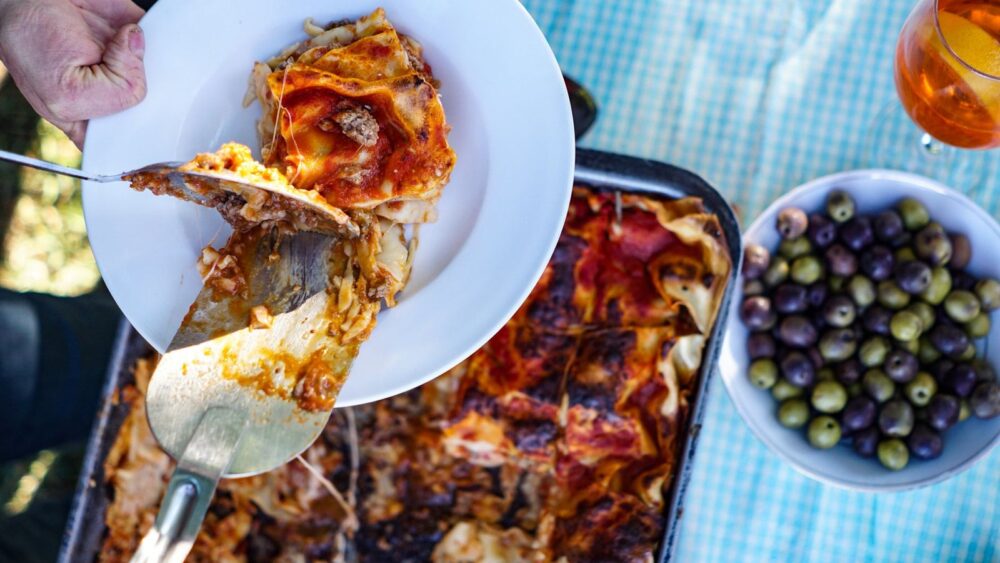

Few dinners feel as generous as a pan of lasagna coming out of the oven. The edges are crisp, the cheese is browned in spots, and the whole kitchen smells like tomato, garlic and basil.
This classic lasagna recipe keeps things traditional: a meaty sauce made with ground beef and Italian sausage, a seasoned ricotta layer, and a generous amount of mozzarella and Parmesan. It takes some time, but most of it is hands-off simmering and baking.
It is also one of the best make-ahead dinners you can have in your back pocket. Assemble it the day before, bake it when you need it, and enjoy the leftovers all week.
Why this recipe works
- Two kinds of meat. Ground beef gives the sauce body, and Italian sausage brings fennel, garlic and seasoning without extra work.
- A thick sauce. Simmering the sauce for 30 minutes cooks off excess water, so the lasagna holds its layers instead of sliding apart on the plate.
- Seasoned ricotta. An egg, Parmesan, parsley and a pinch of salt turn plain ricotta into a creamy layer with real flavor.
- Covered, then uncovered baking. Foil traps steam so everything heats through evenly, and the last stretch uncovered browns the cheese on top.
- A proper rest. Letting the lasagna sit for 15 minutes after baking gives the layers time to set so you get clean squares.
Ingredients you’ll need
The full amounts are in the recipe card below. Here is what matters about the key ingredients and how to swap them.
- Ground beef and Italian sausage. An 85% lean beef works well here. Use mild or hot sausage, casings removed. For an all-beef lasagna, use 2 pounds of ground beef and add 1/2 teaspoon fennel seed and an extra clove of garlic.
- Tomatoes. Crushed tomatoes form the base, tomato sauce loosens it, and tomato paste adds depth. A small pinch of sugar balances acidity if your tomatoes taste sharp.
- Ricotta. Whole-milk ricotta is creamier and less watery than part-skim. If your ricotta looks wet, drain it in a fine-mesh strainer for 15 minutes.
- Mozzarella. Low-moisture mozzarella melts well without releasing water. Shred it yourself from a block if you can, since pre-shredded cheese has anti-caking agents that keep it from melting as smoothly.
- Noodles. This recipe uses regular boiled lasagna noodles. No-boil noodles work too; see the notes in the recipe card for the adjustment.
- Parmesan. A real wedge of Parmesan grated fresh adds nutty, salty flavor to both the ricotta and the top layer.
Ingredient notes and smart substitutions
Ground beef and Italian sausage. 85% lean beef gives flavor without a greasy sauce; avoid 70/30 blends, which leave a slick of fat on top. Bulk sausage saves the step of removing casings. Swap: 1 lb sausage → 1 lb extra ground beef plus 1 tsp fennel seed, 1/2 tsp extra salt and a pinch of red pepper flakes. 1 lb beef → 1 lb ground turkey (cook to 165°F) for a lighter sauce, or 1 lb ground pork for a richer one.
Ricotta. Whole-milk ricotta is creamier and holds together better. Part-skim ricotta works but drain it first. Avoid ricotta with gums or stabilizers if you can; it tends to be grainy. Swap: 15 oz ricotta → 15 oz cottage cheese blended smooth (a common Midwestern substitute, slightly tangier), or 12 oz ricotta plus 3 oz mascarpone for an extra rich layer.
Mozzarella. Low-moisture, whole-milk mozzarella from a block melts best. Fresh mozzarella releases water and makes the lasagna soupy. Swap: 1 lb mozzarella → 12 oz mozzarella plus 4 oz provolone or fontina for more flavor.
Lasagna noodles. Regular dried noodles give the most control. Swap: 12 regular noodles → 12 no-boil noodles (see the recipe notes for the liquid adjustment), 1 lb fresh pasta sheets (no boiling needed, bake covered 30 minutes), or thin planks of roasted zucchini for a low-carb version (salt and roast them first to drive off water).
Crushed tomatoes and tomato sauce. Look for cans with tomatoes, salt and maybe basil, nothing else. Swap: 1 (28 oz) can crushed plus 1 (15 oz) can sauce → 1 (28 oz) can whole peeled tomatoes crushed by hand plus 1 (15 oz) can sauce, or 6 cups of your favorite jarred marinara (skip the added herbs, sugar and salt, then taste).
Parmesan. A wedge of real Parmigiano-Reggiano or a good domestic Parmesan, grated fresh. Swap: 1 cup Parmesan → 1 cup Pecorino Romano (saltier; reduce the salt in the ricotta and sauce by 1/4 tsp each) or Grana Padano.
How to make it
1. Make the meat sauce
Brown the beef and sausage in a large pot over medium-high heat, breaking the meat into small pieces. Let it sit undisturbed for a minute or two between stirs so it actually browns rather than just turning gray. Cook until no pink remains and the meat reaches 160°F.
Drain off most of the fat, leaving about a tablespoon, then add the onion and cook until soft. Stir in the garlic and tomato paste and cook for a minute so the paste darkens slightly. Add the crushed tomatoes, tomato sauce, herbs and seasoning, then simmer uncovered for about 30 minutes, stirring now and then, until the sauce is thick.
2. Boil the noodles and mix the ricotta
While the sauce simmers, cook the noodles in well-salted water until just shy of al dente. They will finish cooking in the oven. Drain them and lay them flat on an oiled sheet pan so they don’t stick together.
In a bowl, stir together the ricotta, egg, Parmesan, parsley, salt and pepper until smooth.
3. Layer the lasagna
Spread a thin layer of sauce over the bottom of a 9×13-inch baking dish. This keeps the first layer of noodles from sticking. Then build three layers of noodles, ricotta, mozzarella and sauce, finishing with noodles, sauce, mozzarella and Parmesan on top.
Spread the ricotta gently with the back of a spoon. It does not need to reach every corner perfectly; it will spread as it bakes.
4. Bake and rest
Cover the dish with foil (lightly greased or tented so it doesn’t touch the cheese) and bake at 375°F for 25 minutes. Remove the foil and bake another 20 to 25 minutes, until the sauce bubbles at the edges and the cheese is golden in spots.
Let it rest for 15 minutes before cutting. It is tempting to skip this, but cutting too soon is the main reason lasagna turns into a sloppy pile.
Common mistakes and how to fix them
Watery lasagna. The most common problem, and it has three causes: a thin sauce, wet ricotta and fresh mozzarella. Simmer the sauce until a spoon dragged through it leaves a trail that fills in slowly. Drain ricotta in a strainer for 15 to 30 minutes. Use low-moisture mozzarella. If the baked lasagna is still loose, let it rest 20 minutes instead of 15; it will firm up as it cools.
Slices that slide apart. The lasagna was cut too soon, or there was too much sauce between layers. Rest the full 15 minutes, and use about 1 1/2 cups of sauce per layer rather than flooding it. A slightly thicker ricotta layer also helps the noodles grip.
Dry, tough edges. The lasagna was baked uncovered from the start, or too long. The foil stage keeps steam in; uncover only for the last 20 to 25 minutes. If the top browns before the center is hot, tent it loosely with foil again.
Noodles stuck together. They sat in a pile after draining. Lay them flat on an oiled sheet pan in a single layer, or drape them over the edge of the colander. If a few stick, run them under warm water and peel them apart gently.
Curdled, grainy ricotta. Part-skim ricotta or ricotta with stabilizers can turn grainy in a hot oven. Use whole-milk ricotta and do not overbake. Mixing in the egg and Parmesan also helps it stay smooth.
Sauce that tastes sharp or metallic. Some canned tomatoes are quite acidic. The teaspoon of sugar helps, and so does the 30-minute simmer. If it still tastes sharp, add 1 tbsp butter at the end of simmering, which rounds the edges without making the sauce sweet.
Timing and make-ahead plan
- Two days before: Make the meat sauce. It keeps in the fridge for 3 days and tastes better after a night, and this is the most time-consuming step.
- The day before: Boil the noodles, mix the ricotta and assemble the whole lasagna in the baking dish. Cover tightly and refrigerate. Shred the mozzarella for the top layer and keep it in a bag.
- Morning of: Take the lasagna out of the fridge 45 minutes to an hour before baking so it does not go into the oven fully cold.
- 1 hour 15 minutes before serving: Heat the oven to 375°F. Bake covered for 40 minutes (15 extra minutes for a cold lasagna), then uncovered for 20 to 25 minutes, until the center reads 165°F.
- 15 minutes before: Rest the lasagna on the counter, loosely tented. Make the salad and warm the bread.
To hold a baked lasagna warm, cover it with foil and keep it in a 200°F oven for up to an hour. For a buffet, cut it into squares in the pan and keep the pan covered on a warming tray, above 140°F.
Tips for the best lasagna
- Brown the meat in a wide pot. Crowding the meat makes it steam. If your pot is small, brown the beef and sausage in two batches.
- Don’t skimp on the simmer. A watery sauce means a watery lasagna. The sauce should mound slightly on a spoon before you start layering.
- Salt the pasta water well. The noodles are a big part of every bite, and this is your only chance to season them.
- Use a sheet pan under the dish. A full 9×13 pan can bubble over, and a rimmed sheet pan underneath saves you from cleaning the oven.
- Check the center. If you baked it straight from the fridge, the middle should read 165°F on an instant-read thermometer before you serve it.
Variations
- Vegetarian lasagna. Swap the meat sauce for our lentil Bolognese, which is thick enough to layer the same way.
- Spinach ricotta. Stir 10 ounces of thawed, well-squeezed frozen spinach into the ricotta mixture.
- Mushroom and sausage. Brown 8 ounces of sliced mushrooms with the onion for a deeper, earthier sauce.
- Extra cheesy. Add a layer of provolone slices under the top layer of mozzarella.
- Smaller batch. Halve the recipe and bake it in an 8×8-inch dish, reducing the uncovered baking time by about 5 minutes.
Equipment that makes this easier
- A 9×13-inch baking dish at least 2 1/2 inches deep. Three full layers rise close to the rim, and a shallow dish overflows.
- A 5- to 6-quart Dutch oven. It gives two pounds of meat room to brown and holds the full sauce as it simmers without splattering the stove.
- A rimmed sheet pan. Two jobs: laying out the boiled noodles so they do not stick, and catching drips under the baking dish in the oven.
- A large pot for the noodles. At least 6 quarts. Long noodles need room to move or they clump and tear.
- An instant-read thermometer. It confirms the center has reached 165°F, which matters most when baking from cold or frozen.
- A box grater. Grating a block of mozzarella takes 3 minutes and melts far better than bagged shreds.
Scaling up or down
To halve it: Use an 8×8-inch or 9×9-inch dish and 6 noodles, trimmed to fit (kitchen shears work well). Halve everything else, using half a beaten egg, about 2 tablespoons, in the ricotta. Bake covered for 25 minutes and uncovered for 15 to 20. The meat sauce halves easily, but it is worth making the full amount and freezing half.
To double it: Build two 9×13-inch lasagnas rather than one deep pan; a doubled depth takes far longer to heat through and the top layers overcook. Brown the meat in batches, since four pounds in one pot will steam. The doubled sauce needs 45 minutes to thicken instead of 30.
Cook the noodles in two rounds so they have room in the pot. If both dishes bake at once, rotate them halfway and add 5 to 10 minutes to the covered stage.
What to serve with it
Lasagna is rich, so pair it with something bright and crisp. A simple green salad with a sharp vinaigrette, roasted green beans or garlic bread are all classic choices. For more ideas, browse our list of fall side dishes that go with everything.
If you’re planning a cozy dinner party, lasagna also fits nicely into a menu from our cozy fall dinner recipes roundup.
How to store, freeze and reheat
Refrigerate: Cover leftovers tightly and keep them in the fridge for up to 4 days.
Make ahead: Assemble the lasagna, cover it and refrigerate for up to 24 hours. Add about 15 minutes to the covered baking time since it will start cold.
Freeze: Wrap the unbaked or baked lasagna in plastic wrap and then foil, and freeze for up to 3 months. You can also freeze individual slices for quick lunches. Our fall freezer meal prep plan has more on wrapping and labeling.
Reheat: Thaw frozen lasagna overnight in the fridge. Bake covered at 350°F for 30 to 40 minutes for a full pan, or until the center reaches 165°F. Single slices reheat in the microwave in 2 to 3 minutes, covered, with a splash of water on the plate to keep them moist.
Leftover ideas
- Crispy fried lasagna squares. Cut cold lasagna into squares, dredge in beaten egg and breadcrumbs and pan-fry in 1/4 inch of oil until golden on both sides. Serve with warm marinara.
- Lasagna soup. Chop a few slices and simmer with 4 cups of chicken broth and a cup of crushed tomatoes for 15 minutes. Top with a spoon of ricotta and basil.
- Lasagna grilled cheese. A thin slice of cold lasagna between buttered bread with extra mozzarella, griddled until the cheese melts.
- Stuffed peppers. Chop leftovers and pack them into halved bell peppers, top with cheese and bake at 375°F for 30 minutes. The turkey stuffed peppers show the basic method.
- Lasagna egg bake. Crumble a slice into a buttered skillet, pour over 4 beaten eggs, cover and cook over low heat until set.
Nutrition notes
One slice (one-twelfth of the pan) comes to roughly 520 to 620 calories, with about 32 to 38 grams of protein, 32 to 38 grams of carbohydrates and 28 to 34 grams of fat. Sausage and cheese drive most of the fat and calories, so the brands you buy and the leanness of the meat shift the totals noticeably.
- Lighter: Use ground turkey in place of the beef, reduce the mozzarella to 12 oz, and use part-skim ricotta (drained well). That saves about 100 to 130 calories per slice.
- Gluten-free: Use gluten-free lasagna noodles (boil them slightly less than the package says, since they soften quickly) and check the sausage label for fillers.
- Dairy-free: This is a stretch for lasagna, but a tofu ricotta (14 oz firm tofu blended with 2 tbsp olive oil, 2 tbsp lemon juice, 2 tbsp nutritional yeast and 1/2 tsp salt) and a plant-based shredded mozzarella make a decent version.
- More vegetables: Add a layer of sautéed spinach or thinly sliced roasted zucchini between the ricotta and sauce without changing the bake time.
Classic Meat Lasagna
A traditional lasagna layered with beef and sausage meat sauce, seasoned ricotta, mozzarella and Parmesan.
Equipment
- Large pot or Dutch oven
- Large pot for pasta
- 9×13-inch baking dish
- Rimmed sheet pan
- Aluminum foil
Ingredients
For the meat sauce
- 1 lb ground beef (85% lean)
- 1 lb Italian sausage, casings removed
- 1 medium yellow onion, finely chopped
- 4 cloves garlic, minced
- 1 (6 oz) can tomato paste
- 1 (28 oz) can crushed tomatoes
- 1 (15 oz) can tomato sauce
- 1/2 cup water
- 2 tsp dried basil
- 1 tsp dried oregano
- 1 tsp sugar
- 1 1/2 tsp kosher salt, plus more to taste
- 1/2 tsp black pepper
- 1/4 cup chopped fresh parsley
For the ricotta filling
- 15 oz whole-milk ricotta
- 1 large egg
- 1/2 cup grated Parmesan
- 2 tbsp chopped fresh parsley
- 1/2 tsp kosher salt
- 1/4 tsp black pepper
For assembly
- 12 regular lasagna noodles
- 1 lb low-moisture mozzarella, shredded (about 4 cups)
- 1/2 cup grated Parmesan
Instructions
- Heat a large pot or Dutch oven over medium-high heat. Add the ground beef and sausage and cook for 8 to 10 minutes, breaking it into small pieces, until browned and no pink remains (160°F). Drain off all but about 1 tablespoon of fat.
- Add the onion and cook for 5 minutes, until softened. Stir in the garlic and tomato paste and cook for 1 minute, until fragrant and the paste darkens slightly.
- Add the crushed tomatoes, tomato sauce, water, basil, oregano, sugar, salt and pepper. Bring to a simmer, then reduce the heat to medium-low and simmer uncovered for 30 minutes, stirring occasionally, until thick. Stir in the parsley and adjust salt to taste.
- Meanwhile, bring a large pot of well-salted water to a boil. Cook the lasagna noodles for 2 minutes less than the package directions. Drain and lay flat on a lightly oiled sheet pan.
- In a medium bowl, stir together the ricotta, egg, Parmesan, parsley, salt and pepper until smooth. Heat the oven to 375°F.
- Spread 1 cup of meat sauce over the bottom of a 9×13-inch baking dish. Top with 4 noodles, overlapping slightly. Spread half of the ricotta mixture over the noodles, sprinkle with 1 cup mozzarella, and spread about 1 1/2 cups of sauce on top.
- Repeat with 4 more noodles, the remaining ricotta, 1 cup mozzarella and 1 1/2 cups sauce. Finish with the last 4 noodles, the remaining sauce, the remaining 2 cups mozzarella and the 1/2 cup Parmesan.
- Cover the dish with lightly greased foil, place it on a rimmed sheet pan, and bake for 25 minutes. Remove the foil and bake for 20 to 25 minutes more, until bubbling at the edges and golden on top.
- Let the lasagna rest for 15 minutes before slicing and serving.
Notes
- Total time includes 15 minutes of resting after baking.
- Make ahead: Assemble, cover and refrigerate up to 24 hours. Add about 15 minutes to the covered baking time.
- No-boil noodles: Use the same number of noodles straight from the box and add 1/2 cup extra water to the sauce. Keep the dish covered for the first 35 minutes.
- Freezing: Wrap well in plastic and foil and freeze up to 3 months. Thaw overnight in the fridge before baking.
- Food safety: If baking from cold, make sure the center reaches 165°F before serving.
Frequently asked questions
Should lasagna be covered when baking?
Yes, for the first part. Covering with foil keeps moisture in so the lasagna heats through evenly. Uncover it for the last 20 to 25 minutes so the cheese browns.
Why is my lasagna watery?
The usual causes are a thin sauce, watery ricotta, or fresh mozzarella. Simmer the sauce until thick, drain wet ricotta, use low-moisture mozzarella, and let the lasagna rest 15 minutes before cutting.
How long should lasagna rest before cutting?
About 15 minutes. This gives the cheese and sauce time to set so the slices hold their shape.
Can I assemble lasagna the night before?
Yes. Cover and refrigerate the assembled lasagna for up to 24 hours, then bake as directed, adding about 15 minutes to the covered baking time.
Do I need an egg in the ricotta?
The egg helps the ricotta set so it doesn’t ooze out of the slices. You can leave it out, but the layers will be a little looser.