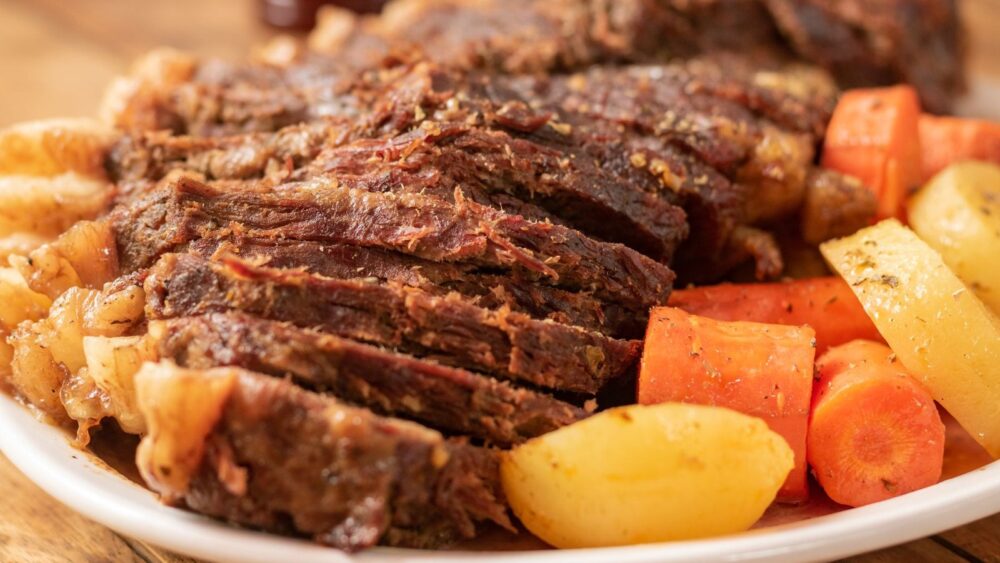

Few dinners are as welcoming as a pot roast that has been cooking all day. This slow cooker pot roast takes about 25 minutes of prep in the morning, then the slow cooker takes over while you get on with your day.
By dinnertime, the chuck roast is fork-tender, the carrots, potatoes and parsnips are soft and full of beefy flavor, and the juices are ready to become a rich, savory gravy in about five minutes.
It is a classic Sunday supper that works just as well on a busy weekday, and the leftovers are good for several meals.
Why this recipe works
- A quick sear first. Browning the roast before it goes into the slow cooker adds deep, roasted flavor that you cannot get from simmering alone. It takes about 10 minutes and is worth it.
- Chuck roast. This well-marbled cut has plenty of connective tissue that breaks down over long, low cooking and turns the meat tender and juicy.
- Vegetables on the bottom. Layering the sturdy root vegetables under the roast keeps them in the flavorful liquid and lifts the meat up so it cooks evenly.
- Not too much liquid. A slow cooker traps moisture, and the roast and vegetables release plenty of juice. Starting with a modest amount of liquid keeps the flavor concentrated.
- A stovetop gravy. Thickening the strained juices with cornstarch in a saucepan gives you a smooth, glossy gravy quickly.
Ingredients you’ll need
Find exact amounts in the recipe card. Here is what to keep in mind.
- Chuck roast. A 3 to 4 lb boneless chuck roast fits well in a 6-quart slow cooker. Look for one with visible marbling. Bottom round or rump roast is leaner and tends to come out drier and more crumbly, so chuck is the best choice.
- Root vegetables. Carrots, baby Yukon Gold potatoes and parsnips hold up well to long cooking. Cut them into large chunks, around 2 inches, so they do not turn mushy. Turnips or rutabaga are good additions.
- Onion and garlic. A thick-cut onion softens into the juices and adds sweetness.
- Beef broth and red wine. Broth adds savory depth and wine adds acidity. If you prefer to skip the wine, use more broth and a tablespoon of balsamic vinegar.
- Tomato paste and Worcestershire sauce. Both add umami, giving the gravy a richer, more rounded flavor.
- Fresh herbs. Thyme and rosemary sprigs plus a couple of bay leaves are traditional. Dried thyme works if that is what you have.
- Cornstarch. Used at the end to thicken the gravy. Mix it with cold water first so it does not clump.
Ingredient notes and smart substitutions
Pot roast is forgiving, but the cut of beef and the amount of liquid make or break it. Here is what matters for each ingredient.
Chuck roast
Look for a boneless chuck roast with plenty of white marbling and a fairly even thickness so it cooks uniformly. A bone-in chuck roast works and adds flavor; allow an extra hour on low. Brisket flat is a good swap that slices neatly but is leaner, so keep it covered in gravy. Round roasts (bottom round, eye of round, rump) come out dry and crumbly in a slow cooker and are best avoided.
Root vegetables
Carrots, baby Yukon Golds and parsnips all survive 8 hours if cut into 2-inch pieces. Substitute rutabaga or turnip for the parsnips in equal weight. Red potatoes work in place of Yukon Golds; russets fall apart. If you want to add sweet potatoes or butternut squash, add them for the final 3 to 4 hours on low only.
Wine and broth
The 1/2 cup of red wine can be replaced with 1/2 cup more broth plus 1 tbsp balsamic vinegar. The total liquid should stay at about 1 1/2 cups; more than that produces a diluted, watery gravy because the slow cooker does not let anything evaporate. Beef broth can be swapped for chicken broth in a pinch, but the gravy will be paler.
Tomato paste and Worcestershire
Swap 2 tbsp tomato paste for 1 tbsp ketchup plus 1 tsp soy sauce if needed. Worcestershire can be replaced 1:1 with soy sauce or coconut aminos for a gluten-free option (some Worcestershire brands contain malt vinegar).
Herbs
Four sprigs of thyme and two of rosemary equal 1 tsp dried thyme and 1/2 tsp dried rosemary. A packet of dry onion soup mix (about 1 oz) is a common shortcut; if you use it, skip the added salt entirely.
Cornstarch
Two tablespoons thickens about 2 cups of juices to a pourable gravy. For a thicker gravy, use 3 tbsp. Flour works too: whisk 3 tbsp flour into 1/4 cup cold water and simmer the gravy for 3 to 4 minutes to cook out the raw taste. Arrowroot is a 1:1 swap for cornstarch and gives a clearer gravy.
How to make it
1. Prep the vegetables
Cut the carrots and parsnips into 2-inch pieces, halve any larger potatoes and cut the onion into thick wedges. Scatter them in the bottom of the slow cooker with the garlic.
2. Season and sear the roast
Pat the roast dry and season it all over with salt and pepper. Sear it in a hot skillet with oil until deeply browned on all sides, about 4 minutes per side. Set it on top of the vegetables.
3. Deglaze the skillet
Lower the heat and stir the tomato paste into the drippings for a minute. Pour in the wine and broth, add the Worcestershire and scrape up the browned bits. Pour this flavorful liquid over the roast and tuck in the herbs.
4. Cook low and slow
Cover and cook on low for 8 to 9 hours or on high for 5 to 6 hours. Low gives the most tender result. The roast is done when it pulls apart easily with two forks.
5. Make the gravy
Move the roast and vegetables to a platter and cover them to keep warm. Strain the cooking liquid into a saucepan, skim the fat and bring it to a simmer. Whisk in a cornstarch slurry and simmer for a minute or two until thickened.
Common mistakes and how to fix them
Dry, stringy roast. Either the wrong cut was used or the roast was left on high for too long after it was done. Fix: use chuck, cook on low when you can, and switch to the warm setting once it is fork-tender. If the meat is already dry, shred it and stir it into the gravy to serve.
Tough roast at the 6-hour mark. Chuck tightens before it relaxes, and a larger roast needs the full time. Fix: keep cooking on low and check every 45 minutes. It is done when a fork twists easily into the center.
Watery, bland gravy. Too much liquid went in, or the vegetables released a lot of moisture. Fix: strain the juices, boil them in a saucepan for 5 to 8 minutes to reduce before adding the cornstarch slurry, and season at the end.
Mushy vegetables. They were cut small, or the cooker ran on high. Fix: keep the pieces at 2 inches, use the low setting, and put the potatoes on the bottom under the carrots where they are protected by the meat above.
Greasy gravy. Fatty chuck releases a lot of fat over 8 hours. Fix: skim the strained liquid with a spoon, or use a fat separator. If you have time, refrigerate the juices for 20 minutes and the fat will firm up on top.
Roast that will not fit under the lid. A 4 lb roast can sit above the rim of a 6-quart cooker when it is stacked on vegetables. Fix: cut the roast into two pieces and lay them side by side. They cook the same and are easier to serve.
Lumpy gravy. Cornstarch was added dry or the slurry went into boiling liquid too fast. Fix: whisk the cornstarch into cold water until smooth, then pour it in a steady stream while whisking constantly.
Timing and make-ahead plan
- The night before: Season the roast with salt and pepper and refrigerate it uncovered. Cut the vegetables and store them in a zip-top bag; keep the potatoes covered in cold water.
- The morning of, 8 to 9 hours before dinner: Sear the roast, deglaze the skillet, load the slow cooker and start it on low. This takes about 25 minutes.
- When it is done: Switch to warm if dinner is more than 30 minutes away.
- 15 minutes before serving: Move the roast and vegetables to a platter, tent with foil, strain the juices and make the gravy.
To hold the roast for guests, keep it on the warm setting in the cooker for up to 2 hours, or return the sliced meat and vegetables to the gravy and hold them in a covered dish in a 200°F oven for up to 1 hour.
Tips for the best slow cooker pot roast
- Do not lift the lid. Each peek lets out heat and can add 15 to 20 minutes to the cooking time.
- Cook it until it is truly tender. If the roast still feels firm, it needs more time. Chuck becomes tough before it breaks down and turns tender.
- Keep the vegetables large. Small pieces can overcook during a long cook. Big chunks stay intact.
- Use the right size cooker. A slow cooker that is one-half to two-thirds full cooks most evenly. For this recipe, a 6-quart model is ideal.
- Season the gravy at the end. The juices concentrate as they cook, so taste before adding more salt.
- Start with a thawed roast. Never put a frozen roast in the slow cooker; it can spend too long in the temperature danger zone.
Variations
- Oven pot roast. Sear the roast in a Dutch oven, add the liquid and vegetables, cover and cook at 300°F for 3 1/2 to 4 hours until fork-tender.
- Mushroom pot roast. Add 8 oz of whole cremini mushrooms with the vegetables for extra earthiness.
- Italian-style. Swap the thyme for oregano, add a can of diced tomatoes and serve over polenta.
- Sweet potato swap. Replace the Yukon Golds with large chunks of sweet potato for a sweeter fall version. Add them for the last 3 to 4 hours on low so they hold their shape.
- Leftover shepherd’s pie. Chop leftover roast and vegetables, mix with gravy and top with mashed potatoes, in the style of this beef and mushroom shepherd’s pie.
Equipment that makes this easier
- A 6-quart slow cooker. The right size for a 3 to 4 lb roast plus vegetables. In an 8-quart cooker the liquid spreads thin and the vegetables sit above it; in a 4-quart the lid will not close.
- A 12-inch heavy skillet. Wide enough to sear the whole roast without steaming and to deglaze afterward.
- A fine-mesh strainer. Straining the juices gives a smooth gravy instead of one full of herb stems and onion bits.
- A fat separator. The easiest way to remove the fat from 2 cups of pan juices in about a minute.
- An instant-read thermometer. Not for doneness (fork-tender is the test) but for confirming leftovers are reheated to 165°F.
- Slow cooker liners or a silicone insert. Optional, but they turn a 20-minute scrub into no cleanup at all.
Scaling up or down
To halve the recipe (3 servings), use a 2 lb chuck roast in a 4-quart slow cooker with half the vegetables and about 3/4 cup total liquid. Cook on low for 6 to 7 hours. In a 6-quart cooker a half batch sits too shallow and can dry out at the edges.
To double the recipe (12 servings), use two 6-quart slow cookers or one 8-quart with two 3 lb roasts side by side. Sear the roasts one at a time in the same skillet, then deglaze once with the doubled wine and broth. Keep the total liquid at about 2 1/2 cups, not 3, since two roasts release more juice. Cook on low for 9 to 10 hours; the extra mass takes longer to come up to temperature. Do not fill any slow cooker past two-thirds full.
What to serve with it
With potatoes and vegetables in the pot, you really only need something fresh and something to catch the gravy.
- Warm dinner rolls or crusty bread.
- A crisp green salad or roasted green beans. For more ideas, see these fall side dishes that go with everything.
If you prefer a one-pot stovetop braise with a thicker gravy, try this classic beef stew.
How to store, freeze and reheat
Refrigerator: Store the roast, vegetables and gravy in airtight containers for up to 4 days. Keeping some gravy with the meat helps prevent it from drying out.
Freezer: Freeze the sliced or shredded roast covered in gravy for up to 3 months. Potatoes can become grainy after freezing, so enjoy those fresh when possible. Pot roast is a great make-ahead option for a fall freezer meal prep session.
Reheat: Thaw overnight in the fridge. Warm the meat and gravy in a covered skillet or saucepan over medium-low heat until hot throughout, or reheat in a covered dish at 325°F for 20 to 30 minutes. Add a splash of broth if needed.
Leftover ideas: Pile shredded pot roast onto toasted rolls with melted provolone and a little gravy for dipping, or fold it into tacos with pickled onions.
Leftover ideas
- French dip sandwiches. Pile warm shredded roast on toasted hoagie rolls with melted provolone and serve the thinned gravy on the side for dipping.
- Pot roast tacos. Crisp the shredded meat in a hot skillet, then serve in tortillas with pickled onions and a little crumbled cheese.
- Beef and vegetable soup. Chop the leftover meat and vegetables, add 4 cups broth and a can of diced tomatoes, and simmer for 20 minutes.
- Pot roast hash. Dice the potatoes and meat, crisp them in a skillet with butter, and top with fried eggs.
- Shepherd’s pie. Mix chopped meat, vegetables and gravy in a baking dish, top with mashed potatoes and bake at 400°F for 25 minutes.
- Pot roast ragu. Shred the meat into the gravy with a cup of crushed tomatoes and toss with pappardelle.
Nutrition notes
One serving (about 6 oz meat with vegetables and 1/4 cup gravy, one-sixth of the recipe) is roughly 520 to 620 calories, 44 to 50 g protein, 32 to 38 g carbohydrates and 22 to 30 g fat. The fat number depends heavily on the marbling of the chuck and how well you skim the gravy. These are estimates; portions, brands and the exact size of the roast all shift them.
- Lighter: Trim the exterior fat before searing, skim the juices thoroughly, and serve slightly smaller portions of meat with extra vegetables.
- Lower carb: Replace the potatoes with 2-inch chunks of turnip or celery root, which cook in the same time.
- Gluten-free: The recipe is gluten-free as long as the Worcestershire and broth are labeled gluten-free; cornstarch is naturally gluten-free.
- Dairy-free: Naturally dairy-free as written.
Slow Cooker Pot Roast with Root Vegetables
A seared chuck roast slow cooked with carrots, potatoes and parsnips until fork-tender, served with an easy gravy.
Equipment
- 6-quart slow cooker
- Large skillet
- Saucepan
- Fine-mesh strainer
Ingredients
For the pot roast
- 1 lb carrots, peeled and cut into 2-inch pieces
- 1 1/2 lb baby Yukon Gold potatoes, larger ones halved
- 2 medium parsnips, peeled and cut into 2-inch pieces
- 1 large yellow onion, cut into 8 wedges
- 5 cloves garlic, smashed
- 1 (3 to 4 lb) boneless beef chuck roast
- 2 tsp kosher salt
- 1 tsp black pepper
- 2 tbsp vegetable oil
- 2 tbsp tomato paste
- 1/2 cup dry red wine
- 1 cup low-sodium beef broth
- 1 tbsp Worcestershire sauce
- 4 sprigs fresh thyme
- 2 sprigs fresh rosemary
- 2 bay leaves
For the gravy
- 2 tbsp cornstarch
- 2 tbsp cold water
- Kosher salt and black pepper, to taste
Instructions
- Place the carrots, potatoes, parsnips, onion and garlic in the bottom of a 6-quart slow cooker.
- Pat the roast dry and season all over with the salt and pepper. Heat the oil in a large skillet over medium-high heat until shimmering. Sear the roast until deeply browned on all sides, about 4 minutes per side. Place the roast on top of the vegetables.
- Reduce the heat to medium. Add the tomato paste to the skillet and stir for 1 minute. Pour in the wine and simmer for 1 minute, scraping up the browned bits. Stir in the broth and Worcestershire sauce, then pour the mixture over the roast.
- Tuck the thyme, rosemary and bay leaves around the roast. Cover and cook on low for 8 to 9 hours or on high for 5 to 6 hours, until the meat is fork-tender and pulls apart easily.
- Transfer the roast and vegetables to a platter and cover loosely with foil. Discard the herb stems and bay leaves.
- Strain the cooking liquid into a saucepan and skim off the fat. Bring to a simmer over medium heat. Stir the cornstarch and cold water together until smooth, then whisk the slurry into the simmering liquid. Cook, whisking, for 1 to 2 minutes, until thickened. Season with salt and pepper to taste.
- Slice or pull the roast into large pieces and serve with the vegetables and gravy.
Notes
- No wine: Replace the wine with more beef broth plus 1 tbsp balsamic vinegar.
- Oven method: Cook in a covered Dutch oven at 300°F for 3 1/2 to 4 hours, until fork-tender.
- Food safety: Always start with a fully thawed roast. Do not cook a frozen roast in a slow cooker.
- Freezing: Freeze meat covered in gravy for up to 3 months. Thaw overnight in the refrigerator before reheating.
Frequently asked questions
Do I have to sear pot roast before slow cooking?
It is not required for safety, but searing adds much deeper flavor to the meat and gravy. If you are short on time you can skip it, but the result will taste milder.
Why is my slow cooker pot roast tough?
It usually needs more time. Chuck roast tightens up before it breaks down and becomes tender. Keep cooking and check every 30 to 60 minutes until it shreds easily.
Should pot roast be cooked on low or high?
Low is best for the most tender texture, about 8 to 9 hours. High works in 5 to 6 hours if you need it sooner.
Can I put a frozen roast in the slow cooker?
No. A frozen roast can stay in the temperature danger zone too long as it slowly warms. Thaw it in the refrigerator first, which usually takes 1 to 2 days.
How much liquid do I need for pot roast in a slow cooker?
About 1 1/2 cups total is enough for a 3 to 4 lb roast. The meat and vegetables release their own juices, so extra liquid only dilutes the flavor.
Can I cook pot roast in the slow cooker overnight?
Yes. Start it on low before bed and it will be ready 8 to 9 hours later. Most slow cookers switch to warm automatically at the end of the timer, where it can hold for 2 to 3 hours. Make the gravy in the morning, refrigerate everything, and reheat at dinner.