
Thanksgiving stress almost always comes from trying to do everything on Thursday. The fix is a calendar. Most of the meal can be made, or at least prepped, days ahead, and the turkey needs a head start no matter what.
This Thanksgiving make-ahead timeline is built for Thursday, November 26, 2026, with a dinner time of 4:00 p.m. Shift the Thursday schedule earlier or later to match your own plans.
Turkey Thawing Math
A frozen turkey needs about 24 hours in the refrigerator for every 4 to 5 pounds. The fridge should be at 40°F or below. Thawing on the counter is not safe, because the outside warms into the danger zone long before the center thaws.
To find your start date, divide the turkey’s weight by 4 and round up. That’s the number of days it needs. Then add one buffer day, because big birds often take longer than the math says, and a thawed turkey keeps safely in the fridge for 1 to 2 days.
Example: an 18-lb turkey divided by 4 is 4.5 days, which rounds up to 5. Five days before Thursday morning is Saturday, November 21. With a buffer day, move it to the fridge on Friday, November 20.
When to Start Thawing for Thanksgiving 2026
- 8 to 12 lb (2 to 3 days): move to the fridge by Sunday, Nov 22.
- 12 to 16 lb (3 to 4 days): move to the fridge by Saturday, Nov 21.
- 16 to 20 lb (4 to 5 days): move to the fridge by Friday, Nov 20.
- 20 to 24 lb (5 to 6 days): move to the fridge by Thursday, Nov 19.
These dates already include the buffer day. Keep the turkey in its original wrapper on a rimmed sheet pan on the bottom shelf so any drips can’t reach other food.
If You Run Out of Time
Use the cold-water method: submerge the turkey, still in its leak-proof wrapper, in cold tap water. Allow about 30 minutes per pound and change the water every 30 minutes. A turkey thawed this way should be cooked right away. You can also roast a turkey from frozen; it takes about 50 percent longer than a thawed bird.
How Big a Turkey?
Plan on about 1 pound of whole turkey per person, or 1 1/2 pounds per person if you want leftovers.
Four Weeks Out: Week of October 26
- Confirm your guest count and write the menu.
- Order a fresh turkey, or buy a frozen one now while selection is good.
- Ask guests what they are bringing and write it on the menu so nothing doubles up.
- Make a master grocery list split into pantry items (buy now) and fresh items (buy the weekend before).
Three Weeks Out: Week of November 2
- Check equipment: a roasting pan with a rack, an instant-read thermometer, heavy-duty foil, a gravy separator, and enough serving dishes and utensils. Put a sticky note on each serving dish with what goes in it.
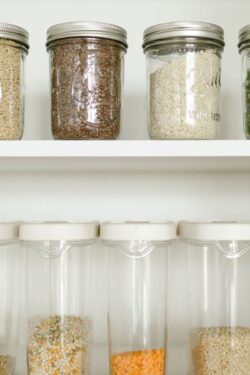
- Shop the pantry list: flour, sugar, broth, canned pumpkin, evaporated milk, spices, bread for stuffing, nuts and wine. Check your spices while you’re at it; our guide to organizing your pantry for fall cooking has a quick spice audit.
- Make and freeze pie dough. Wrapped discs keep in the freezer for up to 3 months. Thaw in the fridge overnight before rolling.
Two Weeks Out: Week of November 9
- Make a gravy base and freeze it. Roast turkey wings or necks at 400°F until browned, simmer with onion, carrot, celery and water for 2 to 3 hours, strain, then thicken with a butter and flour roux. Freeze in quart containers. On Thursday you just rewarm it and whisk in the pan drippings.
- Bake and freeze dinner rolls. Cool completely, bag airtight and freeze.
- Put the frozen turkey in the freezer if it is not already there, and make sure you know its weight.
The Week Before: November 16 to 20
- Clean out the fridge. A 20-lb turkey plus casseroles takes a lot of room. Eat down leftovers and move drinks to a cooler.
- Plan your oven schedule. Write down every dish that needs the oven, its temperature and time. This is where conflicts show up.
- Keep weeknight dinners simple. Lean on easy one-pan meals from our cozy fall dinner recipes or something from the freezer.
- Thursday, Nov 19: turkeys of 20 to 24 lb go into the fridge.
- Friday, Nov 20: turkeys of 16 to 20 lb go into the fridge.
Fridge and freezer space plan
A standard refrigerator holds about 18 to 22 cubic feet, and Thanksgiving week fills it faster than any other week of the year. A 16-lb turkey on a sheet pan takes most of a shelf by itself. Plan the space the same way you plan the oven.
What goes in the freezer, and when it comes out
- Weeks ahead: pie dough, gravy base and dinner rolls, as scheduled above. Together they take about the space of two shoe boxes.
- Frozen turkey: stays in the freezer until its thaw date. A 20-lb bird needs roughly 1 cubic foot.
- Coming out: gravy base and pie dough move to the fridge Monday, rolls to the counter Wednesday. Each move frees freezer space for leftovers on Thursday night.
Shelf-by-shelf fridge plan for the week
Bottom shelf: the turkey, on a rimmed sheet pan, from its thaw date through Thursday morning. Nothing else goes on this shelf while raw poultry is there, and nothing ready to eat goes below it. Once the turkey is in the oven, wash the shelf and it becomes the leftover shelf.
Middle shelf: the day-before dishes. Mashed potatoes in their baking dish, assembled casseroles and stuffing, each covered tightly. Stack them if the dishes have flat lids. Budget half a shelf for a 9×13 plus two 2-quart dishes.
Top shelf: pies, cranberry sauce, salad dressing and the thawing gravy base. Pumpkin pie must be refrigerated, so leave room for it from Tuesday.
Door: butter, eggs, milk, cream and condiments. Keep the cream and extra butter in the door so they do not get buried.
Crisper drawers: celery, cut onions, green beans, fresh herbs, salad greens and apples. Whole onions and potatoes stay in the pantry.
How to make room
- Eat down the fridge during the week of November 16: leftovers, half jars and anything you would not miss.
- Move drinks to a cooler with ice on Wednesday. Beer, wine, soda and water take more fridge space than any dish.
- Use cold weather carefully. An unheated garage or porch works for drinks, but not for the turkey or cooked food, because you cannot control the temperature.
- Consolidate. Move half-used jars into smaller containers and combine the two open cartons of broth.
- Remove the shelf above the turkey if your fridge allows it, and move those items to the door or the drawers for the week.
A cheap fridge thermometer is worth having this week. A packed fridge with the door opening constantly can drift above 40°F, and both the turkey and the pies depend on that number.
Saturday, November 21
- Do the big grocery shop for fresh ingredients: produce, dairy, eggs and fresh herbs.
- Turkeys of 12 to 16 lb go into the fridge.
- Cut bread into cubes and toast them at 300°F for 20 to 25 minutes until dry. Cool and store airtight.
Sunday, November 22
- Turkeys of 8 to 12 lb go into the fridge.
- Make cranberry sauce. Cooked cranberry sauce keeps about 10 days in the fridge, and it tastes better after a few days. Fresh cranberry orange relish keeps about a week.
- Toast nuts for pies, salads and sweet potato topping. Store airtight.
Monday, November 23
- Move the frozen gravy base to the fridge to thaw.
- Thaw the pie dough in the fridge.
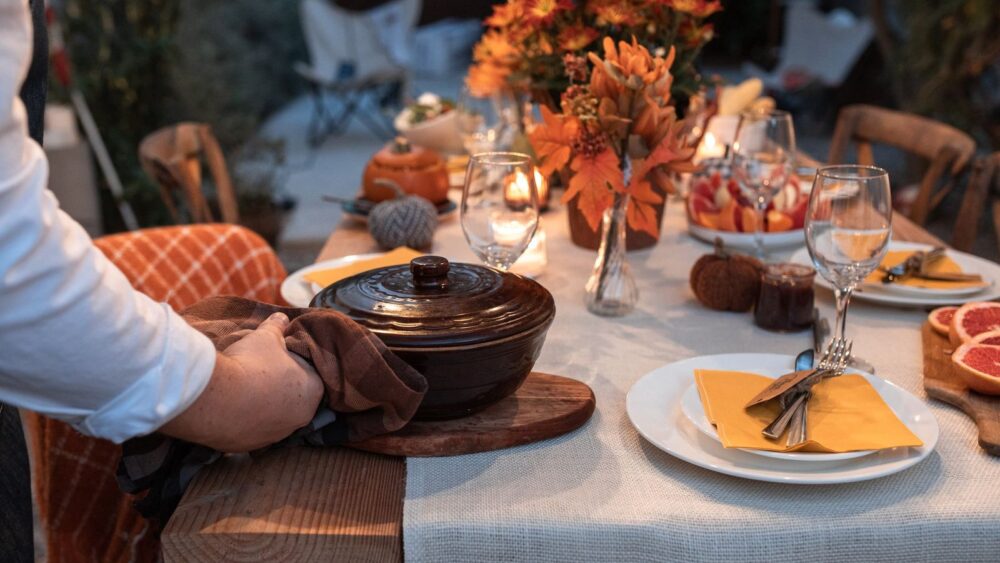
- Set the table, or at least pull out the linens, dishes and glassware and make sure everything is clean.
- Check the turkey. Press the breast; it should be starting to give.
Tuesday, November 24
- Dry brine the turkey if you like. Once it is thawed enough to handle, remove the giblets, pat it dry and rub all over with kosher salt (about 1 tbsp per 5 lb) and any dried herbs. Refrigerate on a rack, uncovered for the last night, for crisp skin.
- Chop the aromatics. Dice onions and celery for the stuffing, and store in airtight containers.
- Bake the pies. Pumpkin and other custard pies must be refrigerated once cool and keep 3 to 4 days. Fruit pies can also be baked Wednesday.
- Make salad dressing and trim green beans.
Wednesday, November 25
- Make the mashed potatoes. Refrigerate in a buttered baking dish or slow cooker insert. They reheat well with an extra splash of warm milk and a few pats of butter.
- Assemble the casseroles. Sweet potato casserole, cheesy broccoli and Brussels sprouts gratin can all be assembled and refrigerated. Keep crunchy toppings in separate bags and add them before baking. Our fall side dishes list has methods for all of these.
- Assemble the stuffing in its baking dish and refrigerate. Bake it separately on Thursday rather than stuffing the bird, which cooks more evenly and more safely.
- Confirm the turkey is thawed. Reach into the cavity; there should be no ice crystals. If there are, run cold water through the cavity until they are gone.
- Take the rolls out of the freezer.
- Set out serving dishes with their labels and set up a drinks station away from the kitchen.
Thanksgiving Day: Thursday, November 26
This schedule is for a 14- to 16-lb unstuffed turkey roasted at 325°F, which takes roughly 3 3/4 to 4 1/4 hours, and a 4:00 p.m. dinner. For other sizes, general unstuffed roasting times at 325°F are 3 to 3 3/4 hours for 12 to 14 lb, 4 1/4 to 4 1/2 hours for 18 to 20 lb and 4 1/2 to 5 hours for 20 to 24 lb.
- 10:30 a.m. Heat the oven to 325°F. Pat the turkey dry, tuck the wing tips, and set it breast side up on a rack in the roasting pan. Brush with melted butter or oil.
- 11:00 a.m. Turkey goes into the oven.
- 12:30 p.m. Take casseroles and mashed potatoes out of the fridge so they aren’t ice cold going into the oven. Put mashed potatoes in a slow cooker on low if using one.
- 1:30 p.m. If the breast is browning too fast, tent it loosely with foil.
- 2:15 p.m. Start checking the temperature. The turkey is done when the thickest part of the breast, the innermost part of the thigh and the thickest part of the wing all read at least 165°F.
- About 3:00 p.m. Turkey out. Tent with foil and rest 30 to 45 minutes; it stays hot. Raise the oven to 375°F.
- 3:05 p.m. Stuffing and casseroles go in. Add crunchy toppings now. Bake until hot and bubbling, 25 to 35 minutes, and the stuffing reaches 165°F in the center.
- 3:15 p.m. Rewarm the gravy base on the stove and whisk in the defatted pan drippings. Reheat mashed potatoes on the stove if they’re not in a slow cooker, stirring in warm milk.
- 3:30 p.m. Cook the green beans on the stovetop. Carve the turkey.
- 3:45 p.m. Rolls in the oven for 5 to 10 minutes. Dress the salad. Put out cranberry sauce.
- 4:00 p.m. Eat.
- By 6:00 p.m. Refrigerate leftovers. Perishable food should not sit out more than 2 hours.
Oven schedule for the day
The timeline above tells you when to start each dish. This section is the oven’s point of view: what is inside at each hour, at what temperature, and what waits its turn. It assumes one standard oven and the 4:00 p.m. dinner.
- 8:00 to 9:00 a.m., 350°F: anything that still needs baking early, such as a fruit pie you did not bake Wednesday, or cornbread. Pull it by 9:00 so the oven is free. If everything is already baked, skip this slot.
- 10:30 a.m., preheat to 325°F. Rack in the lowest position so a 16-lb bird clears the top. Remove the upper rack entirely; it goes back in later.
- 11:00 a.m. to about 3:00 p.m., 325°F: turkey. Nothing else goes in. Every time the door opens the oven loses 25°F to 50°F, so baste no more than once an hour, or not at all. Check the temperature at 2:15, then every 15 minutes.
- 3:00 p.m., turkey out, oven to 375°F. Put the second rack back while the oven is empty, with the two racks in the upper-middle and lower-middle positions.
- 3:05 to 3:40 p.m., 375°F: stuffing and casseroles. Stuffing on the lower rack, since it needs the most heat to reach 165°F in the center, and sweet potato casserole and gratin on the upper rack. Rotate front to back at 3:20. If it does not all fit, the mashed potatoes stay on the stove or in the slow cooker.
- 3:40 p.m., 375°F: rolls. Slide them onto any open spot for 5 to 10 minutes, or use the toaster oven.
- 3:50 p.m., oven off, door cracked. Any dish that cooled while it waited can go back in for 5 minutes of residual heat.
If you have two ovens or a toaster oven
Give the turkey the main oven at 325°F and run the second oven at 375°F from 2:30 p.m. for casseroles and stuffing. The sides finish while the turkey rests, with none of the temperature juggling above. A toaster oven handles the rolls and a 2-quart casserole, but not a 9×13 pan.
Common oven mistakes on the day
- Roasting with a full second rack. Airflow drops and the turkey takes longer. Keep the turkey alone.
- Opening the door to look. Use the oven light and a leave-in probe thermometer if you have one.
- Trusting the pop-up timer. Many pop at 180°F or higher, well past done. Trust your own thermometer at 165°F in three places.
- Baking cold casseroles for the time on the recipe. Dishes straight from the fridge need 35 to 45 minutes, and the center of the stuffing must reach 165°F because it contains eggs and broth.
Handling the Leftovers
Carve the remaining turkey off the bone before refrigerating so it cools quickly. Leftover turkey, stuffing and sides keep 3 to 4 days in the fridge; freeze anything you won’t eat by Monday. Reheat to 165°F.
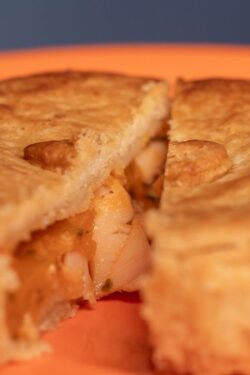
Leftover turkey slots easily into recipes that call for cooked chicken. It is especially good in the filling of a homemade chicken pot pie, and the frozen gravy base doubles as the sauce.
Leftover plan for the weekend after
Thursday’s leftovers are safe through Monday if they went into the fridge by 6:00 p.m. That gives you Friday, Saturday and Sunday to eat them, and a freezer for anything left Monday morning. A rough plan keeps the fridge from becoming a graveyard of foil.
Thursday night: pack it right
- Carve all the turkey off the bone and store it in shallow containers with a spoonful of gravy or broth over the top so it does not dry out. Save the carcass for stock.
- Store stuffing, mashed potatoes and casseroles in containers no more than 2 inches deep so they chill quickly.
- Gravy goes in a jar; it keeps 3 to 4 days and reheats to a simmer in minutes.
- Fruit pies can stay covered at room temperature for up to 2 days. Pumpkin and pecan pies go in the fridge.
Friday: the classic plate, then stock
Lunch is the same plate as Thursday, reheated covered in a 350°F oven for 20 to 25 minutes or in the microwave until steaming. Reheat turkey with gravy or broth in the dish, and take it to 165°F.
In the afternoon, simmer the carcass with an onion, two carrots, two celery ribs and a bay leaf for 2 to 3 hours, then strain. You will get 2 to 3 quarts of stock, which freezes for 3 months or becomes soup on Sunday.
Saturday: turn it into something else
- Turkey pot pie: swap 3 cups of chopped turkey for the chicken in the chicken pot pie filling and use leftover gravy for part of the sauce. Leftover mashed potatoes make a fine top instead of pastry.
- Turkey and wild rice casserole: use the turkey in the chicken and wild rice casserole; the method is the same.
- Stuffing cakes: mix 2 cups of stuffing with 1 beaten egg, form into patties and fry in butter until crisp, 3 to 4 minutes a side. Top with a fried egg and cranberry sauce.
- Mashed potato cakes: 2 cups of mashed potatoes, 1 egg, 1/4 cup flour and a handful of cheese, fried the same way.
- Cranberry sauce goes on turkey sandwiches, into yogurt, or next to Swedish meatballs in place of lingonberry jam.
Sunday: soup and freezer
Turn Friday’s stock into turkey soup: simmer it with diced carrot, celery and onion for 15 minutes, add the last of the turkey and a handful of egg noodles or rice, and cook until tender. Whatever turkey and gravy remain after that get frozen in labeled 2-cup portions before bed; they keep 2 to 3 months.
Casseroles and stuffing also freeze well for up to 2 months. Mashed potatoes freeze best when they are rich with butter and cream; stir well after reheating. Do not freeze the salad or anything that has already been reheated once.
By Monday, the fridge should hold nothing from Thursday but the pie. Toss anything you are unsure about; four days is the limit for cooked turkey and sides.
Quick Make-Ahead Cheat Sheet
- Up to 3 months ahead (frozen): pie dough, gravy base, dinner rolls
- 4 to 5 days ahead: toasted bread cubes, cranberry sauce, toasted nuts
- 2 days ahead: pies, chopped aromatics, salad dressing, dry brine
- 1 day ahead: mashed potatoes, assembled casseroles and stuffing
- Day of: turkey, gravy, green beans, salad, reheating
Frequently asked questions
When should I start thawing my turkey for Thanksgiving 2026?
Thanksgiving 2026 is Thursday, November 26. Allow 24 hours in the fridge per 4 to 5 pounds, plus a buffer day: move a 12 to 16 lb turkey to the fridge by Saturday, Nov 21, a 16 to 20 lb turkey by Friday, Nov 20, and a 20 to 24 lb turkey by Thursday, Nov 19.
How long does it take to thaw a turkey in the refrigerator?
About 24 hours for every 4 to 5 pounds in a refrigerator at 40°F or below. A 16-lb turkey needs about 4 days. Once thawed, it keeps 1 to 2 days in the fridge before cooking.
What Thanksgiving dishes can I make ahead?
Pie dough, gravy base and rolls can be frozen weeks ahead. Cranberry sauce can be made 4 to 5 days ahead, pies 2 days ahead, and mashed potatoes, casseroles and stuffing can be assembled the day before.
What temperature should turkey be cooked to?
Turkey is safe at 165°F, measured with a food thermometer in the thickest part of the breast, the innermost part of the thigh and the thickest part of the wing. Stuffing, whether cooked in or out of the bird, must also reach 165°F.
Can I cook a turkey that is still partly frozen?
Yes. It is safe to roast a turkey from frozen or partly frozen, but it takes longer, up to about 50 percent longer for a fully frozen bird. Remove the giblets once they loosen and check the temperature in several places.