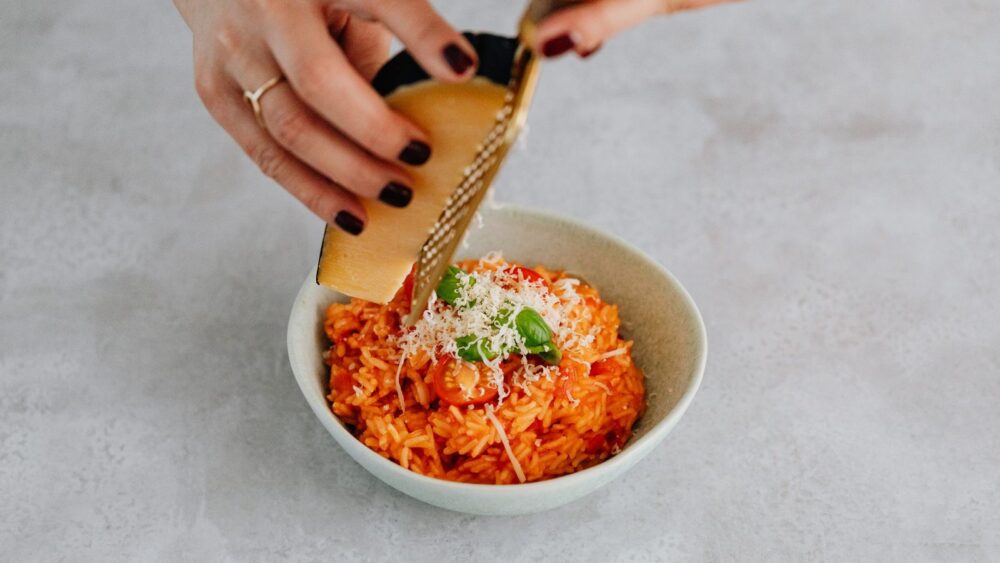

Butternut squash risotto tastes like fall in a bowl. The rice turns creamy and golden, the squash adds natural sweetness, and a handful of sage leaves crisped in butter brings a nutty, savory finish.
There is no cream in this recipe. The silky texture comes from the starch in arborio rice, half the squash cooked right into the pot until it breaks down, and a generous amount of Parmesan stirred in at the end.
Yes, risotto needs your attention for about 25 minutes. But the stirring is easy, the ingredients are simple, and the result is a restaurant-worthy dinner or side dish made in one pot.
Why this recipe works
- Two ways with squash. Half the cubes cook in the risotto and melt into the sauce for flavor and color. The other half roasts in the oven for caramelized edges and texture on top.
- Toasting the rice. A couple of minutes in the hot fat before any liquid goes in helps each grain keep a slight bite in the center.
- Warm broth, added gradually. Hot broth keeps the pot at a steady simmer, and adding it a ladle at a time with frequent stirring rubs starch off the rice to create a creamy sauce.
- A finish of butter and cheese. Stirring cold butter and Parmesan in off the heat makes the risotto glossy and rich.
- Crispy sage. Frying the leaves in butter turns them crisp and mellow, and the sage-flavored butter gets drizzled over the top.
Ingredients you’ll need
You will find the full list with measurements in the recipe card. Here is what to know:
- Butternut squash. A small squash of about 2 lb yields roughly 4 cups of 1/2-inch cubes. To save time, use pre-cut squash from the produce section and cut any large pieces smaller.
- Arborio rice. Its high starch content is what makes risotto creamy. Carnaroli is an excellent alternative. Do not rinse the rice, since you want to keep that starch.
- Broth. Chicken broth gives the richest flavor, and vegetable broth keeps the dish vegetarian. Use low-sodium, because the broth reduces and the Parmesan adds salt.
- Dry white wine. Pinot grigio or sauvignon blanc adds brightness. If you skip it, use more broth and a squeeze of lemon juice at the end.
- Parmesan. Grate it yourself from a wedge. Pre-shredded cheese has anti-caking agents that keep it from melting smoothly. For a vegetarian dish, look for a Parmesan-style cheese made without animal rennet.
- Fresh sage. Dried sage will not crisp, so this is worth buying fresh. If you cannot find it, finish with fresh thyme instead.
- Shallot and garlic. They give a mild aromatic base. A small yellow onion works in place of the shallot.
Ingredient notes and smart substitutions
Risotto has only a handful of ingredients, so each one matters. Here is what to buy, what to skip, and how the common swaps change the bowl.
Rice
Arborio is in every supermarket and makes a creamy, slightly soft risotto. Carnaroli costs more but holds a firmer center and is harder to overcook. Vialone Nano is a third option that cooks a few minutes faster. Do not use jasmine, basmati or long-grain white rice; they lack the surface starch and turn into pilaf.
Butternut squash
A 2 lb squash yields about 4 cups of cubes after peeling. Pre-cut squash saves 10 minutes but is often cut into 1-inch pieces; halve them so the roasted portion browns and the simmered portion breaks down on time. A 12 oz bag of frozen cubes can replace the simmered half; add it frozen and cook 2 to 3 minutes longer.
Broth
You need 6 cups to be safe, though most batches use 5 to 5 1/2. If you run out, hot water works for the last addition. For vegetarian risotto, a mushroom or darker vegetable broth adds depth; avoid very sweet, carrot-heavy vegetable broths, which fight the squash.
Wine
Half a cup of dry white wine adds acidity that keeps the risotto from tasting flat and sweet. Swap it with 1/2 cup broth plus 1 tsp lemon juice at the end, or 1/2 cup dry vermouth, which keeps in the fridge for months.
Parmesan
One cup of finely grated Parmesan from a wedge weighs about 3 oz. Pecorino Romano is saltier and sharper; use 3/4 cup and cut the added salt. Grana Padano is a close, slightly milder swap at the same amount. Pre-shredded cheese clumps instead of melting.
Butter and olive oil
Butter gives flavor and gloss; the oil raises its smoke point for cooking the shallot. For a dairy-free risotto, use olive oil throughout, skip the cheese, and finish with 2 tbsp nutritional yeast and an extra pinch of salt. It will be less creamy but still good.
Sage
Twelve fresh leaves fry into a topping for four bowls. If fresh sage is not available, skip the frying step entirely and stir 1 tsp fresh thyme or 1/2 tsp dried rubbed sage into the risotto with the cheese. Brown the 2 tbsp butter alone and drizzle it on top for a similar nutty note.
How to make it
1. Roast half the squash
Toss half the squash cubes with olive oil, salt and pepper and roast at 425°F until tender and browned at the edges, 25 to 30 minutes. They will be the topping, so this can happen while you make the risotto.
2. Warm the broth
Heat the broth in a saucepan and keep it at a bare simmer over low heat. Adding cold broth to the rice would stall the cooking every time.
3. Cook the squash and aromatics
In a wide, heavy pot, soften the shallot in butter and olive oil, then add the remaining squash and a ladle of broth. Cook until the squash is soft enough to mash against the side of the pot, then add the garlic.
4. Toast the rice and add wine
Stir in the rice and toast it for 2 minutes, until the edges of the grains look translucent. Pour in the wine and stir until it is almost completely absorbed.
5. Add broth gradually
Add warm broth about 1/2 cup at a time, stirring often and waiting until most of it is absorbed before adding more. After 18 to 22 minutes, the rice should be creamy and tender with a slight bite in the center. You may not need all the broth.
6. Finish off the heat
Stir in the Parmesan, a tablespoon of butter and a pinch of nutmeg. The risotto should be loose enough to slowly spread when spooned onto a plate. Add a splash more broth if it is too stiff.
7. Crisp the sage
Fry the sage leaves in butter in a small skillet until they darken slightly and turn crisp, about 30 to 60 seconds, then drain them on a paper towel.
Common mistakes and how to fix them
Gluey, stiff risotto. The rice was cooked too long, the pot was too small so the rice steamed in its own starch, or the risotto sat too long before serving. Fix: pull it when the grains still have a slight bite, and stir in a ladle of hot broth right before plating until it spreads slowly on its own.
Chalky centers after 25 minutes. The broth was added cold, or the heat was too low so the rice sat in liquid without cooking. Fix: keep the broth at a bare simmer in its own pan and the risotto at a lively simmer. If you are past 25 minutes and the rice is still hard, keep going with hot broth; it will get there.
Soupy risotto. Too much broth was added at once, or the last ladle went in right before the cheese. Fix: add broth 1/2 cup at a time and wait until a spoon dragged across the bottom leaves a trail. If it is already soupy, simmer it 1 to 2 minutes uncovered before adding the cheese.
Squash that stays in hard cubes. The simmered half did not cook long enough before the rice went in. Fix: give the squash the full 8 to 10 minutes covered with broth and mash it roughly against the side of the pot. It should look like a chunky purée, not cubes.
Rice sticking and scorching. The heat was too high or stirring stopped during the last 5 minutes, when the starch is thickest. Fix: lower to medium and stir every 20 to 30 seconds near the end.
Cheese that clumps into strings. The Parmesan went in while the pot was still on a high burner. Fix: take the pot off the heat, wait 30 seconds, then stir the cheese in with the butter.
Timing and make-ahead plan
- The day before: Peel and cube the squash and refrigerate it in a bag. Grate the Parmesan and chop the shallot.
- The morning of: Roast the topping squash and keep it at room temperature in a covered container.
- 1 hour before: Warm the broth, cook the shallot and squash, toast the rice and cook the risotto with broth for about 12 minutes, until it is two-thirds done. Spread it on a sheet pan to stop the cooking and cover.
- 10 minutes before serving: Return the par-cooked risotto to the pot with 1 cup hot broth and finish over medium heat for 6 to 8 minutes, then add the cheese and butter. Fry the sage while it finishes.
Finished risotto does not hold well. If guests are running late, keep it off the heat with the lid on for up to 15 minutes and loosen it with hot broth before serving. Rewarm the roasted squash in a 350°F oven for 5 minutes.
Tips for the best butternut squash risotto
- Use a wide pot. A wide Dutch oven or braiser gives the rice more contact with the heat and helps it cook evenly.
- Keep it at a lively simmer. Medium heat is right. Too low and the rice gets soggy; too high and the liquid evaporates before the rice absorbs it.
- Stir often, not constantly. Stirring every 30 seconds or so is enough to release starch and prevent sticking.
- Taste the rice. Timing varies by brand and pot. Start tasting at 16 minutes.
- Serve right away. Risotto thickens as it sits. Have bowls ready and serve it while it is still loose and creamy.
Variations
- Add bacon or pancetta. Crisp 4 oz of diced pancetta before the shallot and use the rendered fat for cooking.
- Brown butter and pecans. Top with toasted chopped pecans and a drizzle of brown butter for extra nuttiness.
- Goat cheese swirl. Replace half the Parmesan with soft goat cheese for a tangy finish.
- Other squash. Kabocha or sugar pumpkin works in place of butternut and cooks in about the same time.
- Add greens. Stir a couple of handfuls of baby spinach or chopped kale into the pot in the last 2 minutes.
Equipment that makes this easier
- A wide, heavy pot or braiser. A 5 to 6-quart pot with a wide base gives the rice room to cook in a shallow layer, which speeds absorption and reduces sticking.
- A 2-quart saucepan for the broth. Keeping the broth simmering next to the risotto is what keeps the timing on track.
- A ladle that holds about 1/2 cup. It makes the gradual additions automatic without measuring.
- A wooden spoon or silicone spatula. Both scrape the bottom of the pot cleanly. A metal spoon can scratch enameled pots.
- A rimmed sheet pan and parchment. The roasted squash browns better spread in a single layer with space between the cubes.
- A rasp-style grater. Finely grated Parmesan melts into the risotto in seconds instead of clumping.
Scaling up or down
To halve the recipe (2 servings), use 3/4 cup rice, 3 cups broth and half of everything else, and switch to a 3-quart saucepan so the rice is not spread too thin. Cooking time stays about the same, 18 to 20 minutes, but the broth absorbs faster, so add it in 1/3-cup additions.
To double the recipe (8 servings), use 3 cups rice and 11 to 12 cups broth in a 7 to 8-quart pot. Doubled risotto takes 25 to 30 minutes rather than 20, since a deeper layer of rice absorbs more slowly, and it needs more frequent stirring because the bottom layer scorches more easily. Roast the topping squash on two sheet pans, rotating them halfway. Toast the rice for a full 3 minutes and add the broth in 1-cup additions.
What to serve with it
A generous bowl makes a satisfying vegetarian main with a green salad. It also works as a side for a simple protein:
- Apple cider pork chops, whose sweet-tangy pan sauce pairs well with squash and sage.
- Sheet pan chicken thighs with root vegetables for an easy roast chicken dinner.
- A spoonful of risotto under red wine braised short ribs makes a special-occasion plate.
How to store, freeze and reheat
Refrigerator: Store leftovers in an airtight container for up to 4 days. Keep the crispy sage separately at room temperature so it stays crisp; it is best within a day.
Freezer: Risotto can be frozen for up to 2 months, but the rice softens and loses some of its bite once thawed. Freezing works best if you plan to turn leftovers into risotto cakes.
Reheat: Warm risotto in a saucepan over medium-low heat with a splash of broth or water, stirring until it is creamy again. The microwave works too; add a splash of liquid and stir every 30 seconds.
Leftover idea: Chill leftover risotto, form it into patties, dredge in breadcrumbs and pan-fry in olive oil until golden on both sides for crispy risotto cakes.
Leftover ideas
- Risotto cakes. Form cold risotto into 3-inch patties, coat in panko, and pan-fry in olive oil for 3 to 4 minutes per side. Serve with a fried egg for brunch.
- Arancini. Roll cold risotto into golf balls around a cube of mozzarella, dredge in flour, egg and breadcrumbs, and shallow-fry at 350°F until golden, about 4 minutes.
- Stuffed peppers or squash. Fill halved bell peppers or a delicata squash with leftover risotto, top with Parmesan and bake at 400°F for 25 minutes.
- Risotto soup. Thin 2 cups of risotto with 3 cups of broth, add a handful of spinach and simmer 5 minutes for a quick lunch.
- Baked risotto gratin. Spread leftovers in a buttered dish, top with breadcrumbs and cheese, and bake at 400°F until crisp on top, about 20 minutes.
Nutrition notes
One main-course serving (one-quarter of the recipe, including the roasted squash and sage butter) is roughly 520 to 600 calories, 16 to 19 g protein, 68 to 76 g carbohydrates and 20 to 25 g fat. Chicken versus vegetable broth barely changes the numbers; the butter and Parmesan drive most of the fat. Estimates vary with brands and portion size.
- Lighter: Use 2/3 cup Parmesan and skip the finishing butter, which trims roughly 80 calories per serving without losing much creaminess.
- More protein: Top each bowl with seared shrimp, a poached egg or shredded rotisserie chicken.
- Gluten-free: Naturally gluten-free as long as the broth is labeled gluten-free.
- Dairy-free: Use olive oil in place of the butter and nutritional yeast in place of the Parmesan; expect a less rich, slightly looser texture.
Butternut Squash Risotto with Sage
Creamy arborio risotto cooked with butternut squash and Parmesan, topped with roasted squash and crispy sage.
Equipment
- Wide Dutch oven or heavy pot
- Saucepan
- Rimmed baking sheet
- Small skillet
Ingredients
For the roasted squash
- 1 small butternut squash (about 2 lb), peeled, seeded and cut into 1/2-inch cubes (about 4 cups), divided
- 1 tbsp olive oil
- 1/4 tsp kosher salt
- 1/8 tsp black pepper
For the risotto
- 6 cups low-sodium chicken or vegetable broth
- 2 tbsp unsalted butter, divided
- 1 tbsp olive oil
- 1 large shallot, finely chopped
- 2 cloves garlic, minced
- 1 1/2 cups arborio rice
- 1/2 cup dry white wine
- 1 cup finely grated Parmesan, plus more for serving
- Pinch of ground nutmeg
- Kosher salt and black pepper, to taste
For the crispy sage
- 2 tbsp unsalted butter
- 12 fresh sage leaves
Instructions
- Heat the oven to 425°F. Toss half of the squash cubes with 1 tbsp olive oil, 1/4 tsp salt and 1/8 tsp pepper on a rimmed baking sheet. Roast for 25 to 30 minutes, turning once, until tender and browned at the edges.
- Meanwhile, bring the broth to a simmer in a saucepan, then reduce the heat to low to keep it warm.
- In a wide Dutch oven over medium heat, melt 1 tbsp butter with 1 tbsp olive oil. Add the shallot and a pinch of salt and cook until soft, 2 to 3 minutes. Add the remaining squash and 1 cup of the warm broth. Cover and cook, stirring occasionally, until the squash is very soft and can be mashed with a spoon, 8 to 10 minutes. Mash it roughly and stir in the garlic for 30 seconds.
- Add the rice and stir for 2 minutes to toast it. Pour in the wine and stir until almost fully absorbed, about 1 to 2 minutes.
- Add the warm broth about 1/2 cup at a time, stirring frequently and letting most of the liquid absorb before adding more. Continue for 18 to 22 minutes, until the rice is creamy and tender with a slight bite in the center.
- Remove the pot from the heat. Stir in the Parmesan, the remaining 1 tbsp butter and the nutmeg. Season with salt and pepper. If the risotto is stiff, stir in a little more warm broth until it loosely spreads on a plate.
- In a small skillet over medium heat, melt 2 tbsp butter. When it foams, add the sage leaves in a single layer and fry for 30 to 60 seconds, until crisp. Transfer to a paper towel and sprinkle with a pinch of salt.
- Spoon the risotto into bowls, top with the roasted squash and crispy sage, drizzle with the sage butter and serve with extra Parmesan.
Notes
- Vegetarian: Use vegetable broth and a Parmesan-style cheese made without animal rennet.
- No wine: Replace the wine with 1/2 cup broth and add 1 tsp lemon juice at the end.
- Side dish: This recipe serves 6 as a side.
- Leftovers: Refrigerate for up to 4 days and reheat with a splash of broth, or turn into pan-fried risotto cakes.
Frequently asked questions
Do you have to stir risotto constantly?
No. Stirring frequently, about every 30 seconds, is enough to release the starch and keep the rice from sticking. Constant stirring is not necessary.
Can I make butternut squash risotto without wine?
Yes. Use an extra 1/2 cup of broth in place of the wine and add a squeeze of lemon juice at the end for brightness.
Can I use frozen butternut squash?
Frozen squash works for the part cooked into the risotto, since it breaks down anyway. It releases more water and does not brown well, so use fresh squash for the roasted topping.
Can I make risotto ahead of time?
Risotto is best fresh. To get ahead, cook it about two-thirds of the way, spread it on a sheet pan to cool quickly, and refrigerate. Finish with warm broth for 6 to 8 minutes just before serving.
What kind of rice is best for risotto?
Arborio is the most widely available and works very well. Carnaroli is a little more forgiving and holds its shape slightly better. Long-grain rice will not give a creamy result.
Why is my risotto gluey?
It cooked too long, sat too long before serving, or was made in a pot that was too small. Pull the rice while it still has a slight bite and loosen it with a ladle of hot broth right before serving so it spreads slowly on the plate.